

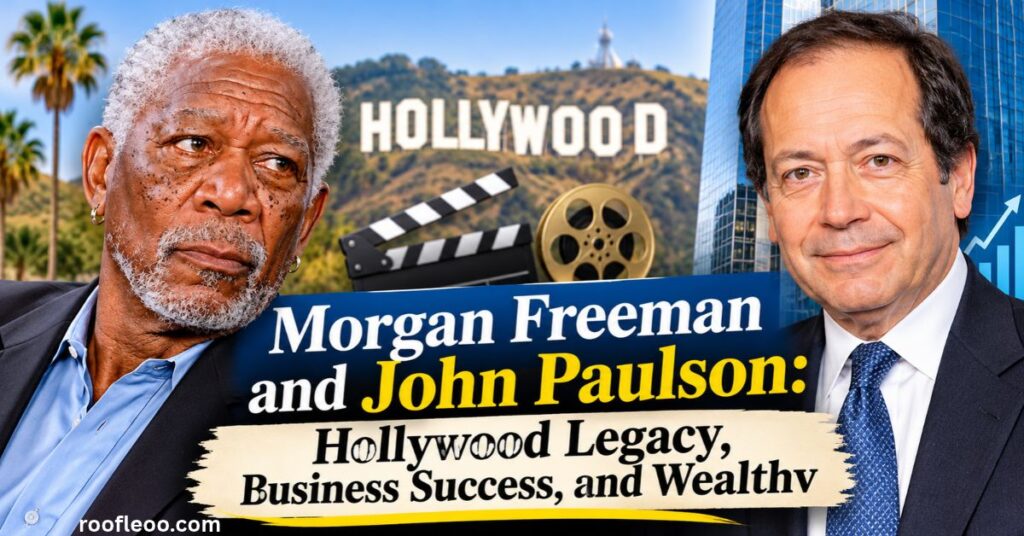
One man built his name on a voice the world trusts. The other built his fortune on a bet almost nobody believed in. Put them side by side, and you get a surprisingly rich story about talent, patience, risk, and the meaning of success.
This guide looks at Morgan Freeman and John Paulson as two separate legends who share one thing: they both rose to the very top of their fields. You’ll see how each one started, how each earned a fortune, and what their journeys can teach you. Along the way, you’ll find tables, case studies, and plain-English explanations.
Let’s dig in.
Who Are Morgan Freeman and John Paulson?
Start with the basics. These two men work in completely different worlds. Their names rarely appear in the same sentence outside of internet searches.
Morgan Freeman is an American actor, narrator, and film producer. He is among the most recognizable performers in cinema history. He has an Academy Award, a Golden Globe, and a Screen Actors Guild Life Achievement Award on his shelf. Millions of people know his calm, rolling voice even if they can’t name a single film.
John Paulson is an American billionaire investor. He founded the hedge fund Paulson & Co. in 1994. He became a household name in finance after his firm profited enormously from the collapse of the housing market in 2007 and 2008. Few people outside Wall Street would recognize his face. Inside Wall Street, he is a legend.
Quick Profile Table
| Detail | Morgan Freeman | John Paulson |
|---|---|---|
| Born | June 1, 1937, Memphis, Tennessee | December 14, 1955, Queens, New York |
| Industry | Film, television, narration, production | Hedge funds and investment management |
| Best known for | The Shawshank Redemption, Million Dollar Baby, narrating March of the Penguins | Profiting from the subprime mortgage collapse |
| Major milestone | Academy Award for Best Supporting Actor (2005) | Roughly $15 billion in firm profits in 2007 |
| Business vehicle | Revelations Entertainment | Paulson & Co. (now a family office) |
| Estimated net worth | About $250 million | About $3 billion to $4 billion |
Why People Search for Both Names Together
So why do readers type Morgan Freeman and John Paulson into the same search box? Usually, curiosity drives it. People enjoy comparing a movie star’s fortune with a financier’s fortune. Wealth lists, “richest in their field” rankings, and trivia pages also tend to group famous names together.
That comparison turns out to be fascinating. One fortune came from creative skill and decades of steady work. The other came from analysis, nerve, and perfect timing.
Morgan Freeman and John Paulson: Is There a Confirmed Connection?
Here’s the straight answer. No confirmed business partnership, joint venture, or shared company links Morgan Freeman and John Paulson. They work in different industries, live very different public lives, and built their careers on separate tracks.
Freeman earns his living in entertainment. Paulson earns his in global finance. Their paths could cross at a charity gala or a high-profile event, since both men move in wealthy circles. Still, no documented joint project defines their relationship.
Why the Pairing Still Makes Sense
A connection doesn’t have to be a business deal to be worth exploring. Think of it like comparing two mountain climbers who chose different peaks. Both reached the summit. Both faced storms. The routes simply looked nothing alike.
Here are the main reasons this comparison works:
- Both rose from modest starts. Freeman grew up in the segregated South. Paulson grew up in a middle-class family in Queens.
- Both took decades to reach the top. Neither man became famous overnight.
- Both turned reputation into an asset. Freeman’s name sells tickets. Paulson’s name once attracted billions in investor money.
- Both gave back. Each has supported education, culture, or community causes.
What You Should Expect From Here
The sections below treat each man separately first. After that, you’ll see direct comparisons of their careers, net worth, philanthropy, and legacies. No shortcuts and no guesswork about a partnership that doesn’t exist.
Morgan Freeman’s Journey From Early Life to Hollywood Recognition
Freeman’s story proves that patience pays. He didn’t become a movie star until his fifties. That fact alone should encourage anyone who feels they started late.
Early Life and Military Service
Freeman was born in Memphis in 1937. His family moved around the Mississippi Delta during his childhood, and he spent formative years in towns like Greenwood and Charleston. He fell in love with performing early. As a child, he took part in school plays. As a teenager, he won a statewide drama competition.
A scholarship to study theater was on the table. Instead, Freeman chose the U.S. Air Force. He served from 1955 to 1959 as an automatic tracking radar specialist. He has said many times that he dreamed of flying fighter jets. Years later, he earned his pilot’s license and still flies today.
After the service, Freeman moved to Los Angeles to chase acting. Work was scarce. He took odd jobs and studied his craft. Eventually, he landed in New York, where the theater scene gave him a real foothold.
The Slow Burn: Stage and Television
Freeman spent the 1960s and 1970s building skills on stage. He appeared in Off-Broadway shows and earned strong reviews. His big television break came in 1971 on the children’s program The Electric Company. He played characters like Easy Reader and Mel Mounds, and he made reading fun for a generation of kids.
Many actors would have called that a lucky break and moved on. Freeman kept working. He took stage roles, small film parts, and anything that sharpened his craft.
The Breakthrough Years
The late 1980s changed everything. Freeman earned an Academy Award nomination for Best Supporting Actor for Street Smart in 1987. Two years later, Driving Miss Daisy brought him a Best Actor nomination and a Golden Globe win.
Then came a run of films that people still quote today:
- The Shawshank Redemption (1994): His role as Ellis “Red” Redding became one of cinema’s most beloved performances.
- Se7en (1995): He played a quiet, thoughtful detective opposite Brad Pitt.
- Million Dollar Baby (2004): This role finally earned him the Oscar for Best Supporting Actor.
- Invictus (2009): His portrayal of Nelson Mandela brought another Oscar nomination.
- The Dark Knight trilogy: As Lucius Fox, he added warmth and wit to Gotham.
The Voice as a Brand
Few actors can say their voice alone is a business asset. Freeman can. His narration of March of the Penguins in 2005 became a cultural moment. Documentaries, commercials, video games, and corporate campaigns followed.
Why does his voice work so well? It sounds calm. It sounds wise. It makes any sentence feel like an important truth. Marketers love that, and audiences trust it.
The Business Side: Revelations Entertainment
In 1996, Freeman and Lori McCreary co-founded Revelations Entertainment. The company produces films and television shows. Its credits include the CBS drama Madam Secretary and the science series Through the Wormhole. Owning a production company lets Freeman earn money beyond acting fees. It also gives him more control over the stories he tells.
Key Moments at a Glance
| Year | Milestone |
|---|---|
| 1955 to 1959 | Serves in the U.S. Air Force |
| 1971 | Joins The Electric Company |
| 1987 | First Oscar nomination for Street Smart |
| 1989 | Driving Miss Daisy earns a Best Actor nomination |
| 1996 | Co-founds Revelations Entertainment |
| 2005 | Wins his Oscar for Million Dollar Baby |
| 2008 | Receives Kennedy Center Honors |
| 2012 | Awarded the Cecil B. DeMille Award |
| 2022 | Receives the AFI Life Achievement Award |
The lesson is simple. What looks like an overnight success usually hides decades of quiet work.
John Paulson Rise in Investment Management
Paulson’s story moves in the opposite direction from Freeman’s. Freeman became famous gradually. Paulson became famous in a single, dramatic stretch of time.
Education and Early Career
Paulson grew up in Queens, New York. He attended New York University and graduated as valedictorian of the NYU Stern School of Business in 1978. Then he went to Harvard Business School, where he earned his MBA in 1980 and graduated as a Baker Scholar. That title goes to students with top academic marks.
His early career followed a classic Wall Street path. He worked in management consulting. He joined Bear Stearns, where he became a partner in mergers and acquisitions. Later, he worked at the firm Gruntal & Co. These jobs taught him how deals work and how companies are valued.
Founding Paulson & Co.
In 1994, Paulson launched his own firm, Paulson & Co. It started small. For years, the firm focused on merger arbitrage. That strategy involves betting on whether announced corporate deals will actually close. It’s steady, careful work. It doesn’t make headlines.
Paulson spent about a decade building a reputation for solid research. Few people outside the industry had heard of him.
The Big Bet: The Subprime Mortgage Trade
Around 2005 and 2006, Paulson noticed something troubling. U.S. housing prices were climbing fast. Banks were handing out loans to borrowers with weak credit. Many of those loans were bundled into complex securities and sold to investors.
His conclusion? The whole thing was a bubble waiting to pop.
Here’s an analogy. Imagine buying fire insurance on a house that everyone swears can’t burn. The premium costs very little. If the house stays standing, you lose a small amount. If it catches fire, you collect a fortune. Paulson did something similar with the housing market. He bought credit default swaps, which work like insurance policies on risky mortgage securities.
Most of Wall Street thought he was wrong. Then the housing market collapsed.
The results were staggering:
- Paulson’s firm earned roughly $15 billion in profits during 2007.
- Paulson personally took home an estimated $3.7 billion that year.
- One of his funds posted returns of several hundred percent in 2007.
Financial writers called it one of the greatest trades in history. His name became famous overnight.
Case Study: Why the Trade Worked
Let’s break down the thinking behind the bet.
- He studied the data. Paulson’s team tracked loan quality, home prices, and default rates.
- He spotted a mismatch. The securities were priced as if defaults would stay low.
- He chose a cheap way to bet. Credit default swaps cost little compared with the potential payout.
- He held firm. Even when the trade looked wrong in the short term, he stuck with his research.
This is the textbook definition of a contrarian bet. Everyone else saw safety. Paulson saw risk.
Later Moves: Gold and Mixed Results
After 2008, Paulson’s firm grew rapidly. At its peak around 2011, Paulson & Co. managed roughly $38 billion. He then made large bets on gold and on the economic recovery. Gold prices were rising, and for a while the strategy looked smart.
Then gold fell sharply in 2013. Several of his funds lost significant money. Other positions, including a large investment in the pharmaceutical company Valeant, also hurt returns. Investors pulled out money. Assets dropped well below $10 billion over the following years.
In recent years, Paulson transitioned Paulson & Co. into a family office. That means the firm now manages mainly his own wealth rather than outside investors’ money. It’s a quieter chapter. However, it shows a man who still invests with confidence.
Comparing Their Careers and Public Influence
Now for the fun part. Let’s line up Morgan Freeman and John Paulson and see how their careers compare.
Side-by-Side Comparison
| Category | Morgan Freeman | John Paulson |
|---|---|---|
| Path to success | Decades of stage, TV, and film work | A decade of steady investing, then one huge trade |
| Core skill | Storytelling and a trusted voice | Research, valuation, and risk analysis |
| Risk style | Gradual career choices | Concentrated, high-stakes bets |
| Public visibility | Very high, a global face and voice | Moderate, famous mostly in finance and business circles |
| Source of influence | Trust and emotional connection | Capital and market conviction |
| Peak moment | Oscar win in 2005 and decades of iconic roles | The 2007 subprime profits |
| Business structure | Production company and ventures | Hedge fund, now a family office |
Influence Through Trust Versus Influence Through Capital
Freeman holds influence because audiences believe him. When he narrates a film about penguins, you listen. When he plays a prison inmate with a good heart, you care. His power grows from emotion.
Paulson holds influence because money moves markets. When a famous investor makes a big bet, other investors pay attention. His power grows from numbers.
Fame Versus Financial Prominence
Here’s a simple test. Show a hundred people a photo of Freeman. Almost everyone will recognize him. Now show the same people a photo of Paulson. Very few will know who he is.
Yet Paulson’s single trade made more money than most Hollywood stars earn in several lifetimes. Fame and fortune don’t always travel together. That’s one of the more interesting takeaways from comparing Morgan Freeman and John Paulson.
Morgan Freeman’s Net Worth and Sources of Income
Let’s talk money. Freeman’s net worth is estimated at roughly $250 million. That puts him among the wealthiest actors in the world. Different outlets report slightly different totals, which we’ll explain below.
Where the Money Comes From
Freeman earns income from several streams. Acting is only part of the picture.
| Income Stream | What It Includes |
|---|---|
| Film and TV roles | Lead and supporting parts, often at top-tier fees |
| Narration and voice work | Documentaries, commercials, video games, and brand campaigns |
| Production earnings | Profits and fees through Revelations Entertainment |
| Endorsements | Commercial campaigns that rely on his trusted voice |
| Business ventures | A blues club in Clarksdale, Mississippi, and his ranch |
| Residuals and royalties | Ongoing payments from classic films |
The Power of Residuals
Think about The Shawshank Redemption. It performed modestly at the box office in 1994. Over the years, it became one of the most-watched and most-loved films ever made. Cable, streaming, and home video keep it in circulation. Each replay can generate income for those who hold a stake.
That’s the quiet engine behind a long career. A great role keeps paying for decades.
Business Ventures in Mississippi
Freeman co-founded Ground Zero Blues Club in Clarksdale, Mississippi, in 2001. Clarksdale sits in the heart of blues country. The club celebrates the music born in that region and draws tourists from around the world. He also owns a ranch near Charleston, Mississippi, where he raises animals and keeps beehives.
These aren’t just investments. They reflect his roots. Freeman has said he feels a deep pull toward the place that shaped him.
Why Net Worth Numbers Vary
You might see Freeman’s wealth listed as $200 million in one place and $250 million in another. Why? Several reasons explain it:
- Private assets like real estate and production stakes are hard to value.
- Celebrities don’t publish their finances.
- Estimates rely on reported salaries, deals, and public records.
- Tax obligations and spending change the real total.
Treat any net worth figure as a well-informed estimate. It shows scale, not a bank statement.
John Paulson Net Worth and Investment Wealth
Paulson’s wealth looks very different. Today, his net worth is generally estimated between $3 billion and $4 billion. At its peak in the early 2010s, his fortune was reported at well above $10 billion.
That drop tells an important story. Billionaire wealth tied to markets rises and falls with investments.
What Drives His Wealth
| Wealth Driver | Details |
|---|---|
| Subprime trade profits | The foundation of his fortune, earned in 2007 and 2008 |
| Management and performance fees | Hedge funds charge a share of assets and profits |
| Gold and commodities | Large positions that helped at first and hurt later |
| Real estate | Luxury properties and development investments |
| Hospitality holdings | Stakes in hotels and related properties |
A Hedge Fund Payday in Plain English
New to finance? Here’s how hedge fund money works.
Traditionally, a hedge fund charges two kinds of fees. First, a management fee covers operating costs. It’s usually a small percentage of the money the fund manages. Second, a performance fee takes a cut of the profits. The classic model has been “two and twenty,” meaning 2 percent of assets and 20 percent of gains.
Now picture a fund managing billions of dollars. If it earns a massive return, the performance fee alone can reach billions. That’s how Paulson earned an estimated $3.7 billion in a single year. His own money also grew alongside investors’ money.
Rises and Falls Over Time
Paulson’s fortune hasn’t moved in a straight line. Consider this rough timeline:
- Before 2007: A respected but little-known fund manager.
- 2007 to 2008: A historic payday from the housing collapse.
- 2009 to 2011: Rapid growth in assets and fortune, helped by the gold rally.
- 2013 onward: Gold losses, tough years, and investor outflows.
- Recent years: A smaller, quieter family office managing mostly personal capital.
Even after the decline, Paulson remains a billionaire. That fact shows how large his peak wealth was.
Different Approaches to Building Long-Term Success
Freeman and Paulson reached the top by almost opposite methods. Studying both can sharpen your own thinking.
Freeman: Patience, Craft, and Reputation
Freeman built his career brick by brick. He accepted small roles. He studied his craft. He protected his reputation by choosing projects carefully. Over time, that steady effort created a brand people trust.
His approach has four main pillars:
- Patience: He waited decades for major recognition.
- Craft: He kept improving as a performer.
- Reinvention: He moved from stage to children’s TV to film to production.
- Reputation: Directors and audiences knew he delivered quality.
Paulson: Conviction, Research, and Contrarian Courage
Paulson took a different route. He spent years doing careful research. Then he concentrated his bets on ideas he believed in deeply. When most people called him wrong, he stayed calm.
His approach rests on these ideas:
- Deep research: He studied the data before acting.
- Concentration: He made large bets instead of spreading money thin.
- Independence: He accepted being the lone voice in the room.
- Timing: He recognized when the market had mispriced risk.
How Each Handled Setbacks
Every career includes bad stretches. Freeman faced years of rejection before his breakthrough. He also appeared in a few forgettable films along the way. He kept going and let better roles define him.
Paulson faced steep losses after the gold downturn. Some investors left. Critics questioned his judgment. He adapted by reshaping his firm into a family office. Neither man pretended setbacks didn’t happen. Both adjusted and moved forward.
The House Analogy
Think of it this way. Freeman built a house brick by brick over fifty years. Every brick mattered. Paulson found one load-bearing beam that held up the entire structure of the housing market, then pushed on it at exactly the right moment. Both methods can build something remarkable. They simply demand different temperaments.
Philanthropy and Contributions Beyond Their Main Careers
Wealth gives people a choice. They can keep it or share it. Both men have chosen to give in meaningful ways.
Morgan Freeman’s Giving and Community Work
Freeman has supported education and community causes in Mississippi. He also helped raise awareness and funds for hurricane relief in the Gulf Coast region after Hurricane Katrina in 2005. His connection to his home state runs deep, and much of his charitable energy flows there.
One of his most charming projects involves bees. In 2014, Freeman turned part of his Mississippi ranch into a sanctuary for honeybees. He brought in dozens of hives. His goal was to support pollinators, which are vital for food crops. He has joked that he doesn’t even like honey much. He cares about the bees because they matter.
John Paulson’s Major Gifts
Paulson’s giving comes with bigger headline numbers.
| Gift | Year | Amount | Purpose |
|---|---|---|---|
| Harvard School of Engineering and Applied Sciences | 2015 | $400 million | Largest gift in Harvard’s history at the time. The school now carries his name. |
| Central Park Conservancy | 2012 | $100 million | Helped restore and maintain New York’s famous park |
The Harvard gift, in particular, drew national attention. It supports research, faculty, and student programs in engineering and applied sciences. For a graduate of Harvard Business School, it was a powerful way to return something to the university.
Two Styles of Giving
Notice the difference. Freeman’s giving tends to be personal and regional. It centers on Mississippi, on his own land, and on causes he can see up close. Paulson’s giving tends to be institutional. It targets major universities and iconic public spaces.
Both approaches matter. Neighborhood projects change lives locally. Large gifts reshape institutions for generations.
Public Perception, Reputation, and Media Attention
Public image shapes a legacy. Here, Morgan Freeman and John Paulson have followed very different paths.
Freeman: The Voice People Trust
Freeman’s public image is warm and wise. Fans often describe his voice as the “voice of God.” He has played presidents, a prison mentor, a chauffeur’s friend, and a revered world leader. Over time, those roles shaped how people see him.
That image took a hit in 2018. A news report included allegations from several women about inappropriate behavior on film sets and in other work settings. Freeman issued a public apology. He said he would never intentionally make anyone feel uncomfortable. He also denied that he had assaulted anyone. The episode led to some lost endorsements and a period of lower visibility. He later returned to work and continued acting and narrating.
Handling this topic fairly means acknowledging both facts. The allegations existed. His response existed too. Readers can weigh them for themselves.
Paulson: The Wall Street Legend With Critics
Paulson’s reputation splits in two. On one side, he is the man who made one of the boldest trades in history. Financial books and documentaries have told his story.
On the other side, critics note his later struggles. His gold bets lost money. His funds underperformed for years. Some investors felt let down after the big wins of 2007 and 2008.
His name also surfaced in connection with a legal controversy. A Goldman Sachs deal tied to mortgage securities drew regulatory attention. Goldman settled with the SEC for $550 million in 2010. Paulson himself was not charged with wrongdoing. Paulson also drew political attention when he advised Donald Trump’s 2016 presidential campaign on economic matters.
Different Reactions to Scrutiny
Freeman tends to respond to controversy with brief public statements and then returns to work. Paulson keeps a lower profile, speaks rarely, and lets his investment results do the talking.
Both approaches show something important. In public life, how you respond often matters as much as what happened.
Lessons From Their Professional Journeys
What can you actually take away from Morgan Freeman and John Paulson? Quite a lot. Here are five lessons you can apply to your own career.
Play the Long Game
Freeman didn’t win his Oscar until age 67. He spent decades improving. Real expertise rarely arrives quickly.
Try this: Pick one skill and commit to a five-year growth plan. Small improvements add up faster than you’d expect.
Trust Your Research and Your Instincts
Paulson didn’t guess. He studied mortgages, defaults, and housing data for months before betting big. Then he trusted what he found, even when peers disagreed.
Try this: Before making a big decision, collect facts first. After that, don’t let loud opinions drown out solid evidence.
Build a Brand People Believe In
Freeman’s reputation for quality made his name valuable. Directors wanted him because audiences trusted him. Paulson’s reputation attracted billions in investor capital.
Try this: Deliver consistent work. Reliability becomes your calling card.
Diversify Beyond Your Core Talent
Freeman didn’t stop at acting. He built a production company, opened a club, and developed a voice-work career. Paulson spread into real estate and hospitality alongside investing.
Try this: Find ways to make your main skill earn money in more than one way.
Stay Humble About Wins and Losses
Both men faced criticism and setbacks. Freeman weathered a reputational crisis. Paulson weathered investment losses. Neither disappeared.
Try this: Treat a win as a result, not an identity. Treat a loss as a lesson, not a verdict.
Quick Summary Table
| Lesson | Freeman’s Example | Paulson’s Example |
|---|---|---|
| Play the long game | Oscar win after decades of work | A decade of research before the big trade |
| Trust your research | Careful role selection | Deep analysis of mortgage data |
| Build a brand | The trusted voice | A reputation for bold conviction |
| Diversify | Production, club, ranch | Real estate, hotels, family office |
| Stay humble | Responding to criticism publicly | Adapting after gold losses |
Quotes and Ideas That Reflect Their Careers
Short quotes can capture a whole philosophy. Here are a few ideas tied to each man’s journey.
Freeman’s Reflections
In The Shawshank Redemption, Freeman’s character delivers one of the most famous lines about hope: “Hope is a good thing, maybe the best of things.” That sentiment fits his own story. He kept hoping through many lean years.
Freeman has also spoken about aging and work with a calm, practical attitude. He has said in various interviews that he sees acting as a craft he enjoys, not a burden. He has no interest in slowing down while he still loves it. Many fans admire that steady love of the job.
In a well-known 2005 interview, he offered a blunt view on racism. His suggestion was simply to stop talking about it as a category and treat each other as individuals. People have debated that idea for years. It remains one of his most quoted comments.
Paulson’s Perspective on Risk
Paulson rarely gives flashy quotes. His ideas show up in his actions. In interviews, he has described his approach as finding situations where the potential gain far outweighs the potential loss. In the subprime trade, the cost of insurance was small. The payoff was huge. That “asymmetric” thinking sits at the center of his style.
He has also acknowledged that markets can humble even the best investors. His later struggles with gold and other holdings showed that past brilliance doesn’t guarantee future results.
Ideas Worth Remembering
- Hope fuels persistence. Freeman’s career proves it.
- Cheap bets with big upside beat expensive bets with small upside. Paulson’s trade proves it.
- Reputation compounds. Both men benefited from it.
- Even legends face setbacks. Both men did too.
Understanding Their Broader Legacy
Legacy asks a big question. What will remain when the headlines fade?
Freeman’s Legacy
Freeman’s legacy lives on screen and in sound. Generations will watch The Shawshank Redemption and hear that gentle voice. He has become a cultural reference point. People use his name to describe calm wisdom. Younger actors cite him as an inspiration.
His production work and Mississippi ventures add depth. They show an artist who cared about telling stories and supporting his home region.
Paulson’s Legacy
Paulson’s legacy sits in financial history. His subprime trade appears in business school case studies, books, and documentaries. It’s a lesson in contrarian thinking and disciplined research. His giving, especially to Harvard and Central Park, also leaves visible marks in the physical and academic world.
Yet his story also carries a warning. Even a brilliant trade doesn’t make an investor immune to later mistakes. That honesty makes his legacy more human.
Art Versus Money
Comparing the two raises a thoughtful point. Art tends to endure in memory. A great performance can touch people for a hundred years. Money tends to endure in institutions. A gift to a university or park can support learning and recreation for generations.
Neither type of legacy is better. They simply work through different channels. That’s what makes Morgan Freeman and John Paulson such an interesting pair to study together.
Frequently Asked Questions
Who are Morgan Freeman and John Paulson?
Morgan Freeman is an Oscar-winning American actor, narrator, and producer. John Paulson is a billionaire investor who founded the hedge fund Paulson & Co. They work in different industries and have separate careers.
Are Morgan Freeman and John Paulson business partners?
No. There’s no confirmed business partnership between them. Freeman operates in entertainment through ventures like Revelations Entertainment. Paulson operates in finance. Their names appear together mainly in comparisons of wealthy public figures.
What is Morgan Freeman best known for?
Freeman is best known for acting in films like The Shawshank Redemption, Million Dollar Baby, Driving Miss Daisy, and Invictus. His deep, calming narration also made him one of the most recognizable voices in the world.
Why is John Paulson famous?
Paulson became famous for betting against the U.S. housing market before the 2008 financial crisis. The trade earned his firm roughly $15 billion in 2007 and made him one of the most celebrated investors in modern finance.
Who is wealthier, Morgan Freeman or John Paulson?
Based on widely published estimates, Paulson is wealthier. His net worth is estimated between $3 billion and $4 billion. Freeman’s is estimated near $250 million. Exact figures vary because both men hold private assets.
Do Morgan Freeman and John Paulson work in the same industry?
No. Freeman works in entertainment, including film, television, and narration. Paulson works in finance and investing. Their careers rarely overlap, though both men have built businesses beyond their original fields.
What can people learn from Morgan Freeman and John Paulson?
You can learn patience from Freeman and conviction from Paulson. Both men show the value of reputation, steady skill building, and adapting after setbacks. Their stories prove that success can take many shapes.
Conclusion
Two lives. Two industries. One shared lesson about what it takes to rise.
Freeman built his career through craft, patience, and a voice that audiences trust. Paulson built his through research, nerve, and one of the boldest trades ever recorded. Their wealth differs by billions. Their fame differs by miles. Yet both men turned talent and persistence into lasting influence.
The big takeaway is encouraging. You don’t need one single formula to succeed. You can grow slowly like an oak or strike like lightning. What matters is knowing your strengths, doing your homework, and staying steady when others doubt you.
When you think about Morgan Freeman and John Paulson together, remember this: legacy isn’t only about what you earn. It’s about what remains after you’ve done the work.
What do you think? Would you choose Freeman’s slow-and-steady path or Paulson’s high-conviction approach? Share your thoughts, and keep exploring the stories of people who shaped their fields.

