


One star won four Stanley Cups on skates. The other turned a simple jersey dress into a global fashion empire. They worked in different worlds and chased different dreams. Yet both ended up in front of the same artist’s camera.
That artist was Andy Warhol. He had a gift for spotting people who already owned the public’s attention. He photographed them and turned their faces into bold silkscreen art. Wayne Gretzky and Diane von Furstenberg both made that exclusive list.
So what do these two icons share? Is there a story hiding behind the shared portrait sessions? This article walks through the facts. You’ll see how Warhol connects them and why Gretzky’s portrait shows up under two years. You’ll also learn what each star did with life after the spotlight dimmed. Finally, we’ll answer the big question honestly: does the evidence show a personal relationship?
Here’s what we’ll cover:
- How Warhol links the two stars
- The 1983 versus 1984 dating puzzle for Gretzky
- Von Furstenberg’s place in Warhol’s photography
- What the portraits reveal about Warhol’s subjects
- Whether the evidence supports a real friendship
- A side-by-side look at both careers
- Life beyond fame for each of them
Grab a coffee. Let’s skate right in.
How Andy Warhol Connects Wayne Gretzky and Diane von Furstenberg
Warhol did more than paint soup cans. By the 1970s he had built a busy portrait business. Wealthy collectors, socialites, athletes, and entertainers lined up to sit for him. Each sitter paid for a custom set of silkscreened canvases. Many of the pieces ended up in living rooms and boardrooms around the world.
That business is the common thread here. When you search for Wayne Gretzky and Diane von Furstenberg together, the Warhol studio is where the paths cross.
Warhol as a portraitist of celebrity
Warhol understood something early. Fame was a kind of raw material. He didn’t need to invent glamour because his sitters already carried it. His job was to frame it, boost the color, and make it unforgettable.
Think of a Warhol portrait as a red-carpet moment that never ends. A photographer snaps a movie star on opening night. The picture runs once and fades. A Warhol portrait freezes that same energy and hangs it on a wall for decades.
He also summed up his view of fame in a line that is now famous itself:
“In the future, everyone will be famous for fifteen minutes.”
The quote is widely attributed to Warhol. Whatever its exact origin, it fits his work. Warhol watched fame flicker and fade. He chose sitters who seemed built to last.
Two very different fields, one shared artist
Hockey and fashion don’t seem to overlap. One world smells like ice and sweat. The other smells like perfume and fresh fabric. Still, Warhol moved easily between them.
Here’s why that makes sense:
- Warhol collected stars, not sports or styles. He cared about recognizability above everything else.
- Both fields produce public figures. A top athlete and a top designer both live under constant public attention.
- Galleries and patrons shaped his client list. Dealers often matched Warhol with famous people they believed would sell well or raise his profile.
Seen that way, a hockey legend and a fashion queen aren’t strange neighbors in his portfolio. They’re two examples of the same rule.
What “connection” means here
Before we go further, we need to define one word. When people say two celebrities are “connected,” they might mean several different things. Let’s separate them.
| Type of connection | What it means | Does it apply here? |
|---|---|---|
| Shared subject matter | Both appeared in the same artist’s work | Yes |
| Shared social circles | Both moved in overlapping high-profile worlds | Plausible, with limits |
| Personal friendship | A direct and documented bond | Not confirmed in the evidence reviewed |
We’ll test each idea as we go. The first one is easy. The other two take more care.
Wayne Gretzky’s Portraits: Why Both 1983 and 1984 Appear
If you search for Warhol’s Gretzky work, you’ll notice something odd. Some listings show 1983. Others show 1984. That small gap confuses a lot of readers. It deserves a clear answer.
The dating puzzle
The simplest explanation is that different items carry different dates. Warhol’s process involved several stages. A photo session happened first. Prints and canvases came later. Catalogs, auction houses, and museums don’t always date by the same rule.
Here are the most likely reasons both years appear:
- The photo session and the finished artwork may fall in different years. A Polaroid shot in one year can become a silkscreen the next.
- Some catalogs date by the session. Others date by completion. Neither is wrong. They just use different standards.
- Series can span more than one year. Warhol often produced a set of images over many months.
- Secondary sources copy each other. One early listing can spread a date across dozens of websites.
So the 1983 versus 1984 gap doesn’t mean one source is lying. It means the same project can carry two correct labels depending on what you count. Most catalogs treat 1984 as the year of the finished portraits. Earlier dates usually point to the photo stage.
From Polaroid to silkscreen
To see why one sitter can produce many dated items, you need to know how Warhol worked. His method followed a steady routine.
- Photograph the sitter. Warhol often used a Polaroid camera. He shot many frames to find one that popped.
- Select the best image. He picked the frame with the strongest face and the cleanest lines.
- Enlarge and simplify. The photo was turned into a high-contrast graphic.
- Make a silkscreen. The image was transferred to a mesh screen for printing.
- Add color. Assistants and Warhol himself painted bold backgrounds and tinted details.
- Print multiple versions. Each sitter received a set, and each canvas could differ in color.
Because of those steps, a single sitting could create a pile of related works. A catalog might date the Polaroids to the session and the prints to the finished year. That’s why you’ll see two numbers attached to the same athlete.
Gretzky Career At The Time
Why did Warhol want a hockey player at all? Look at where Gretzky stood in the early 1980s.
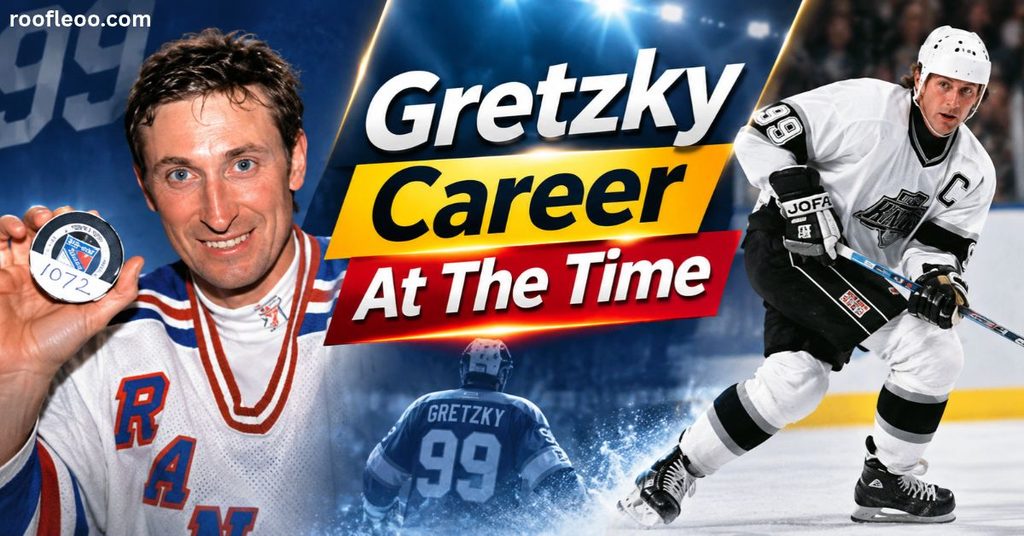
Wayne Gretzky was born on January 26, 1961, in Brantford, Ontario. By his early twenties he had already rewritten the record book. He joined the NHL with the Edmonton Oilers in 1979. In the 1981-82 season he scored 92 goals, a single-season mark that still stands. In 1985-86 he recorded 215 points, another number no one has matched.
The Oilers also became a dynasty. They won the Stanley Cup in 1984, 1985, 1987, and 1988. So when Warhol’s studio made the portraits, Gretzky was climbing toward the top of the sports world.
He was also something rarer. He was a crossover star. Casual fans who didn’t follow hockey still knew his name. His face sold products, filled magazines, and drew crowds. For an artist who prized recognizability, he was a perfect match.
One of his most famous lines captures his mindset:
“I skate to where the puck is going to be, not where it has been.”
The saying is widely credited to Gretzky, who has said it came from his father. It describes how he played. It also describes how Warhol worked, since the artist picked subjects who were heading for even bigger fame.
Quick-reference table
Here’s a simple guide to the dating confusion. Treat it as a reading aid rather than a catalog record.
| Stage | Typical year listed | What it usually refers to |
|---|---|---|
| Photo session | 1983 (often cited) | Polaroids or reference photographs |
| Finished portraits | 1984 (most common) | Silkscreen canvases and prints |
| Later sales or exhibits | Varies | Auction listings and museum records |
If you ever see both years in the same article, don’t panic. Ask one question. Is the source describing the photo or the final piece? That one question clears up most of the mystery.
Case study: One athlete, several dated works
Picture a collector who buys a Gretzky print at auction. The listing says 1984. A friend shows a photo of a Polaroid from the same project labeled 1983. The collector wonders if one of them is a fake.
Neither is. The Polaroid captures the session. The print captures the finished product. The two dates describe two steps in one process. The lesson is simple. Always check what a date is measuring before you call it wrong.
Diane von Furstenberg’s Place in Warhol’s Photography
Now let’s turn to the fashion side. Diane von Furstenberg appears in Warhol’s world more than once. Her story helps explain why.
Who she was in the 1970s and 80s
Diane von Furstenberg was born Diane Simone Michelle Halfin on December 31, 1946, in Brussels, Belgium. She moved into fashion young. She married Prince Egon von Fürstenberg in 1969 and became known by the name she still uses. Soon after, she launched her own line.
Her big breakthrough came in 1974 with the wrap dress. It was soft and simple. It flattered many body types. A woman could slip it on and walk out the door feeling polished. The dress became a symbol of independence for working women.
The public noticed. In 1976 she landed on the cover of Newsweek, which called her a fashion powerhouse. She sold millions of dresses. She also became a fixture of New York nightlife, where artists, models, and designers mixed.
Her personal story has had several chapters. She married media executive Barry Diller in 2001 after a relationship that stretched back decades. She has two children from her first marriage, Alexandre and Tatiana.
She has also given the world one of fashion’s best-known slogans:
“Feel like a woman, wear a dress!”
That line sums up her brand. It was never about pretension. It was about confidence.
Warhol’s repeated interest in her
Warhol returned to von Furstenberg more than once. He produced portrait work of her in the 1970s, and later images followed in the 1980s. He also photographed her in more casual moments.
That repetition matters. Warhol didn’t treat every sitter the same way. Some people appeared once. Others came back across the years. Return visits usually meant that a sitter stayed relevant, stayed visible, or stayed part of his orbit.
Here’s what her place in his work suggests:
- She was a recognized style leader. Her wrap dress made her a symbol of an era.
- She lived in his social world. New York’s art and fashion crowds overlapped heavily.
- Her image sold. Warhol’s patrons liked famous and photogenic sitters.
You should confirm exact titles, dates, and counts of her portraits through museum and foundation catalogs before citing them in a formal setting. The general pattern is clear though. She was a repeat subject rather than a one-time visitor.
Photography versus painting
Many people know Warhol for his colorful canvases. Yet his photographs matter just as much for history. He carried a camera nearly everywhere. He snapped parties, dinners, and chance encounters.
Those pictures work like a visual diary. They show who stood near whom at a certain moment. They also reveal how tightly the creative, fashion, and entertainment worlds were woven together.
His writing adds another layer. His published diaries and his magazine, Interview, gave readers a running account of nightlife and gossip. They help historians figure out who moved in which circles. They can’t prove every friendship though. A name in a diary shows contact. It doesn’t always show closeness.
How her image fits the fashion-icon mold
Warhol photographed many designers and style leaders. Von Furstenberg fits that group neatly. Her portrait style leans on bold features, strong eyes, and a confident pose. Warhol liked faces that read well when simplified.
Compare her with a typical athlete portrait. The athlete’s image often stresses strength and focus. The designer’s image stresses poise and presence. Both rely on a clear, strong face. Both give the viewer an instant sense of who the person is.
That shared visual language is part of why Wayne Gretzky and Diane von Furstenberg can sit comfortably in the same body of work.
What Their Portraits Reveal About Warhol’s Subjects
Look at enough Warhol portraits and a pattern emerges. The sitters aren’t random. Each one reveals how the artist thought about fame and value.
Fame as the common currency
Warhol treated fame like money. Some people had a lot of it and some had little. He liked to work with those who had plenty.
Both stars in this story built personal brands that went beyond their jobs. Gretzky wasn’t just a good scorer. He was “The Great One,” a title that turned him into a symbol. Von Furstenberg wasn’t just a designer. She was the face of a dress, a lifestyle, and later a whole company.
That kind of identity is what Warhol wanted. A name that people recognize at a glance makes a stronger portrait than a skilled worker nobody has heard of.
Patterns across his sitters
Warhol’s client list included athletes, designers, actors, musicians, and heirs. They differed in many ways. Yet they shared a few traits.
Here’s a quick comparison of what each portrait tends to emphasize:
- Athletes: Strength, focus, and star power. The image often shows a calm and determined face.
- Designers: Style, confidence, and taste. The pose often feels polished and self-aware.
- Actors: Charm and drama. The image often leans toward glamour.
- Heirs and socialites: Status and presence. The image often highlights elegance.
Despite those differences, nearly every portrait carries three things:
- Recognizability. Viewers should know the face right away.
- Ambition. Most sitters had built something through effort.
- Strong visual presence. Their faces held up under high contrast and bold color.
Commissions versus friendships
Here’s a point many readers miss. A large share of Warhol’s portraits were commissions. A patron, a gallery, or the sitter paid for the work. Others came through introductions made by dealers.
That changes how you should read a portrait. A commissioned painting says the sitter had fame, money, or access. It doesn’t automatically say the sitter and Warhol were close. Plenty of people sat for him once and never saw him again.
Think of it like a wedding photographer. The photographer captures an important day beautifully. That doesn’t make the photographer a best friend of the couple. The portrait shows a professional exchange. Friendship is a separate question.
Case study: The commission trap
Imagine a researcher who finds a Warhol portrait of a famous businessperson. She assumes the two were close. Then she reads the gallery’s records. A dealer arranged the sitting and the client paid the studio’s standard fee. There’s no letter, diary entry, or photo of the two together afterward.
Her first assumption was reasonable. It was also wrong. The portrait proved a business arrangement and nothing more. This kind of mistake is common whenever people study celebrity art.
Reading a portrait as a historical document
Portraits also tell us about the era. The early 1980s prized glamour, ambition, and spectacle. Warhol’s bold colors matched that mood. They showed a culture that loved celebrity and wasn’t shy about it.
When you look at Gretzky’s image, you see the rise of the modern superstar athlete. Sports had become entertainment and endorsements. When you look at von Furstenberg’s image, you see fashion turning into a lifestyle brand. Women’s clothing had become a statement of independence.
Both portraits capture a moment when personal brands grew bigger than the people behind them.
Does the Evidence Establish a Personal Relationship Between Wayne Gretzky and Diane von Furstenberg?
Now we reach the question many readers care about most. Did these two know each other? Let’s separate what we know from what we only guess.
What the record shows
A few facts are solid:
- Both sat for Warhol or appeared in his work. The artist produced portraits or images of each.
- Both lived in high-profile worlds during the same decades. Their careers peaked in overlapping eras.
- Both became lasting public figures. Each has stayed visible for decades.
That’s the safe ground. Everything beyond it needs proof.
What the record doesn’t show
Here’s the honest part. Based on the sources reviewed for this article, there’s no confirmed evidence of a direct friendship or business tie between Wayne Gretzky and Diane von Furstenberg. No known joint project exists. No widely cited interview describes a close bond. No famous photograph shows the two together as friends.
That doesn’t prove they never met. Two people who attend big events in New York or Los Angeles can easily cross paths. It simply means the public record doesn’t establish a relationship.
The table below makes the difference clear:
| Documented evidence | Reasonable inference | Unsupported claim |
|---|---|---|
| Both appear in Warhol’s body of work | Both moved in famous circles | They were close friends |
| Their careers overlapped in time | They may have attended some of the same events | They worked together |
| Both became global brands | They likely knew of each other | They shared a long relationship |
A good rule is to treat the left column as fact. Treat the middle column as a maybe. Treat the right column as unproven until someone shows real evidence.
Why people assume a link anyway
The human brain loves patterns. When two famous people share an artist, an era, and a level of fame, we tend to connect the dots. It feels natural to guess they knew each other.
Here are the main reasons the guess feels so tempting:
- Shared artist. Appearing in the same portfolio feels like belonging to the same club.
- Shared decade. People who peaked at the same time seem like natural neighbors.
- Shared fame. Celebrities seem to orbit the same parties and events.
- Search results. When an article places two names together, readers assume a link exists.
That last point matters. Search engines group names that show up in the same documents. Seeing two names side by side doesn’t mean anyone verified a bond.
How to read claims responsibly
You’ll meet many online claims about celebrity connections. Here are a few quick tips for judging them:
- Ask what the source actually shows. A shared portrait isn’t the same as a shared dinner table.
- Look for firsthand evidence. Interviews, letters, diaries, and dated photos beat vague statements.
- Watch the wording. Phrases like “reportedly” or “is said to” often hide a lack of proof.
- Check who benefits. Sellers, promoters, and click-driven sites may stretch a connection to boost interest.
Use those four habits and you’ll avoid most celebrity myths.
Two Careers Compared: Professional Journeys of Wayne Gretzky and Diane von Furstenberg
Let’s step back and compare their paths. They climbed different mountains. Yet their journeys share a surprising rhythm. Each started with talent. Each added grit. Each turned success into something bigger.
Wayne Gretzky: from Brantford to the Hall of Fame
Gretzky’s story starts on a backyard rink in Brantford, Ontario. His father, Walter, flooded the yard every winter. Young Wayne skated for hours. By age ten he had scored a stunning number of goals in youth hockey. People in Canada already talked about him.
He turned pro as a teenager. He played briefly in the World Hockey Association before the Oilers entered the NHL in 1979. From there the records fell one after another.
Here are some of the key moments in his playing career:
- 1979: Joins the NHL with Edmonton.
- 1981-82: Scores 92 goals in a single season.
- 1984, 1985, 1987, 1988: Wins four Stanley Cups with the Oilers.
- 1988: Gets traded to the Los Angeles Kings, a deal that shook Canada.
- 1996: Moves to the St. Louis Blues and then to the New York Rangers.
- 1999: Retires from the NHL and enters the Hockey Hall of Fame the same year.
His career totals still stagger people. He finished with 894 goals and 1,963 assists for 2,857 points, and he holds dozens of league records. The NHL honored him by retiring his number 99 across the entire league. No other player will ever wear it.
For the record, Gretzky stands about six feet tall and played at roughly 185 pounds. He was never the biggest player. He won with vision, timing, and an uncanny feel for the game.
Diane von Furstenberg: from Brussels to the CFDA
Von Furstenberg’s road looks different but feels similar. She grew up in Belgium and studied in Europe. As a young woman she moved toward fashion. She worked in the trade and learned how clothing was made and sold.
Her breakthrough was the 1974 wrap dress. It was easy to wear and easy to love. It spread fast. The dress turned her into a household name almost overnight.
Success didn’t run in a straight line though. Her business went through ups and downs. She relaunched her brand in the late 1990s and found a new generation of customers. The wrap dress returned to fashion and reclaimed its place as a classic.
Here are the major beats of her professional journey:
- 1969: Marries Prince Egon von Fürstenberg and gains the name she still uses.
- 1974: Launches the wrap dress.
- 1976: Appears on the cover of Newsweek.
- Late 1990s: Relaunches the brand and rebuilds its reach.
- 2006: Becomes president of the Council of Fashion Designers of America (CFDA), a leadership role she held for years.
- 2014: Publishes her memoir, The Woman I Wanted to Be.
Her CFDA leadership matters because it shows her influence beyond her own label. She helped shape American fashion by supporting young designers and pushing the industry forward.
Side-by-side table
| Category | Wayne Gretzky | Diane von Furstenberg |
|---|---|---|
| Field | Professional hockey | Fashion design |
| Born | January 26, 1961, in Brantford, Ontario | December 31, 1946, in Brussels, Belgium |
| Breakthrough moment | Joining the NHL in 1979 and breaking scoring records | Launching the wrap dress in 1974 |
| Signature achievement | Four Stanley Cups and 2,857 career points | A global brand and the CFDA presidency |
| Public image | “The Great One,” humble and team-focused | Confident, independent, and stylish |
| Warhol link | Portrait work in the early 1980s | Portrait work and photographs from the 1970s onward |
| Age in late 2026 | 65 | 79 (turning 80 on December 31, 2026) |
The table shows how two very different people built lasting legacies. They also show how the phrase Wayne Gretzky and Diane von Furstenberg can describe two stories of reinvention rather than a single shared story.
Net worth and business footprint
You’ll often see questions about money, so let’s address them. Public estimates place Gretzky’s net worth at roughly $250 million. His income grew from salary, endorsements, business ventures, and investments. Von Furstenberg’s wealth is harder to pin down because her fortune ties into her brand and her family finances. Estimates generally land in the hundreds of millions of dollars. Both figures are estimates rather than audited numbers, so treat them as ballpark ranges.
Life Beyond Fame: What Wayne Gretzky and Diane von Furstenberg Did Next
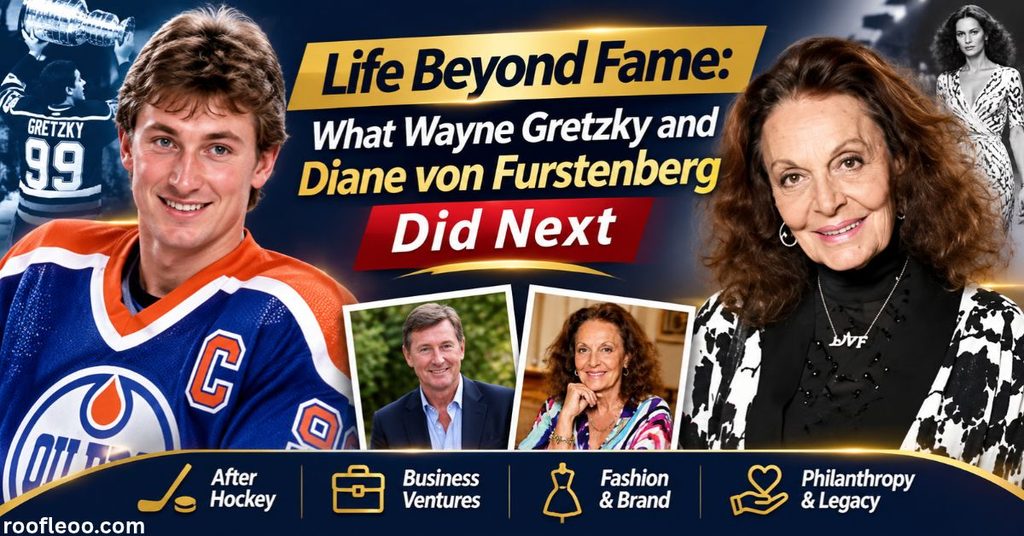
Fame can end suddenly. A player retires. A trend fades. What happens next reveals a lot about a person. Both stars handled that moment with creativity.
Gretzky after the ice
Gretzky didn’t vanish when he retired in 1999. He stayed close to the game. He took on several roles.
Here’s a quick look at what he did:
- Coaching: He coached the Phoenix Coyotes from 2005 to 2009. The team never made the playoffs during his run, and he stepped down afterward.
- Ownership and leadership: In 2021 he joined the Edmonton Oilers’ parent company as a partner and vice chairman, tying him back to the team that made him famous.
- Broadcasting: He later worked as a studio analyst, sharing insight with a new generation of viewers.
- Business ventures: He launched a wine brand in Ontario’s Niagara region, along with other products carrying his name.
- Family life: He married actress Janet Jones in 1988. They have five children and live a relatively private life despite his fame.
Gretzky’s post-career path also shows how he turned his name into a brand. He’s honored in Canada and recognized as one of the greatest athletes in sports history.
Von Furstenberg after the runway
Von Furstenberg’s second act focused on giving back. She and Barry Diller created the Diller-von Furstenberg Family Foundation. It supports causes in the arts, education, and public life.
Her work includes:
- Philanthropy: The foundation has funded projects such as park spaces and public art in New York City. Their support helped bring the Little Island park on the Hudson River to life.
- Women’s advocacy: She launched the DVF Awards, which honor women who show courage and leadership.
- Leadership in fashion: Her CFDA role gave her a platform to mentor younger designers.
- Writing and speaking: Her memoir and public talks share lessons about independence and self-belief.
She often says that the most important relationship in your life is the one you have with yourself. That idea runs through her brand and her charity work.
Case study: Reinvention in practice
Consider how each star handled a hard moment. When Gretzky was traded from Edmonton in 1988, many Canadians felt shocked and heartbroken. He moved to Los Angeles and helped grow hockey in a warm-weather market. His move brought new fans to the sport and opened doors for later teams in the Sun Belt.
When von Furstenberg’s business cooled, she didn’t quit. She studied what went wrong and rebuilt her brand with a fresh approach. She leaned on the wrap dress, which remained her strongest asset. The relaunch put her back at the center of fashion.
Both stories show the same lesson. A setback can become a springboard.
What both stories teach
Here are a few lessons you can take from Wayne Gretzky and Diane von Furstenberg:
- Start with a strong signature. Gretzky had his vision and Number 99. Von Furstenberg had her wrap dress.
- Stay curious after success. Neither stopped at the first big win.
- Build a brand that lasts. Both turned a talent into a name people trust.
- Give back. Both used their platforms to support others.
- Expect change. Careers shift, and the best people shift with them.
Fame opens doors. Reinvention keeps them open.
Frequently Asked Questions About Wayne Gretzky and Diane von Furstenberg
Did Andy Warhol really make portraits of both Wayne Gretzky and Diane von Furstenberg?
Yes. Warhol produced portrait work of Gretzky in the early 1980s and created portraits and photographs of von Furstenberg across several years. For exact titles, dates, and edition counts, check museum and foundation catalogs.
Why do sources list Gretzky’s portrait under two different years?
Different sources date different stages of the project. The photo session may fall in one year while the finished silkscreens carry another. Catalogs and auction houses also follow different dating rules, so both years can appear without either being wrong.
Were Wayne Gretzky and Diane von Furstenberg friends?
The public record doesn’t confirm a direct friendship. Both appear in Warhol’s body of work and both lived in prominent circles, but no widely documented evidence shows a close personal bond. Treat claims of a friendship with caution until someone provides firsthand proof.
What is Diane von Furstenberg best known for?
She’s best known for the wrap dress, which she launched in 1974. She’s also known for building a global fashion brand, leading the Council of Fashion Designers of America, and supporting philanthropic causes with her husband, Barry Diller.
What did Wayne Gretzky do after retiring from hockey?
After retiring in 1999, Gretzky coached the Phoenix Coyotes, worked in broadcasting, built business ventures such as a winery, and returned to the Edmonton Oilers’ ownership group as a partner and vice chairman in 2021. He also stays active in charity and community work.
How old are Gretzky and von Furstenberg now?
As of November 2026, Gretzky is 65 and von Furstenberg is 79. She turns 80 on December 31, 2026.
How tall is Wayne Gretzky?
Gretzky stands about six feet tall, or roughly 183 centimeters. He played at around 185 pounds, which was modest for an NHL star.
Conclusion: What Warhol’s Lens Really Tells Us
We started with a simple question. How do Wayne Gretzky and Diane von Furstenberg connect? The answer lives in Warhol’s studio. Both sat in front of his camera. Both became part of his catalog of fame.
Along the way we solved a small puzzle. Gretzky’s portrait carries two years because a photo session and a finished artwork can carry different dates. We also looked at von Furstenberg’s recurring place in Warhol’s photography, which shows how long she stayed relevant.
We also stayed honest about the big question. The evidence shows a shared artist. It doesn’t show a confirmed personal bond. A portrait proves fame and access. It doesn’t prove friendship.
What stands out most is how each star handled life beyond fame. Gretzky turned his name into coaching, ownership, and business ventures. Von Furstenberg turned hers into philanthropy and leadership. Neither one let the spotlight define the ending.
So here’s a question for you. Which journey inspires you more: the hockey legend who rewrote the record books or the designer who dressed a generation? Share your thoughts in the comments. And if you enjoyed this deep dive, stick around for more stories about the people behind the portraits.

