

Picture a quiet kid from Kalamazoo, Michigan, who dreams of playing shortstop at Yankee Stadium. Now picture a banker’s son from Kobe, Japan, who dreams of building an online mall. They never shared a locker room or a boardroom. Yet Derek Jeter and Hiroshi Mikitani sit at opposite ends of one of the most famous player transfers in modern baseball.
The bridge between them is a pitcher named Masahiro Tanaka. In 2014 he left Mikitani’s Rakuten Golden Eagles and joined Jeter’s New York Yankees. That single move rippled through two continents, two leagues, and two very different business empires.
This guide walks you through each man’s early life, career, and business ventures. You’ll also see how their paths connect, how they compare, and why the 2014 deal still matters. One note up front: the two men are linked through a business transaction. No joint venture, partnership, or public friendship exists between them. That’s the honest picture, and it makes the story more interesting, not less.
Who Is Derek Jeter?
Derek Jeter is a retired American shortstop and a business executive. He spent all 20 of his major league seasons with the New York Yankees. Fans called him “The Captain.” Opponents called him a nightmare in October.
Here are the quick facts:
| Detail | Fact |
|---|---|
| Full name | Derek Sanderson Jeter |
| Born | June 26, 1974, in Pequannock, New Jersey |
| Raised in | Kalamazoo, Michigan |
| Height | 6 feet 3 inches |
| Position | Shortstop |
| MLB career | 1995 to 2014 (Yankees only) |
| Jersey number | 2 (retired by the Yankees in 2017) |
| Hall of Fame | Inducted 2020 |
| Estimated net worth | About $200 million |
The net worth figure comes from Celebrity Net Worth, which lists it at $200 million as of June 2026. Career salary alone accounts for roughly $265 million before taxes. Endorsements and investments added to that total.
Derek Jeter’s Early Life
Jeter’s story starts with his parents. His father, Charles Jeter, is African American and worked as a substance abuse counselor. His mother, Dorothy, is Irish American and worked as an accountant. They met while serving in the military and raised Derek and his younger sister, Sharlee, in a close, structured home.
The family lived in Kalamazoo, Michigan. Every summer, though, the Jeters traveled to New Jersey to visit Derek’s grandparents. His grandmother took him to Yankees games. He fell in love with the team and told anyone who’d listen that he would play shortstop for them someday.
His parents didn’t laugh. Instead they set up a contract. Each year they listed goals for him to meet, including grades and behavior. They taped the contract to his bedroom door. He had to earn his dream.
At Kalamazoo Central High School he hit .508 as a senior. He was named the national high school player of the year. The Yankees drafted him sixth overall in 1992. Several teams passed on him first. The Houston Astros, with the top pick, took someone else. That decision became one of baseball’s most famous misses.
The Playing Career That Built a Legend
Jeter reached the majors in 1995 and won the American League Rookie of the Year award in 1996. That same year, the Yankees won the World Series. It was the first of five titles under his watch.
Here’s what his résumé looks like:
- Five World Series championships (1996, 1998, 1999, 2000, and 2009)
- 14 All-Star selections
- 3,465 career hits, sixth on the all-time list
- A .310 career batting average
- 260 home runs and 358 stolen bases
- Five Gold Glove awards and five Silver Slugger awards
- Yankees captain from 2003 to 2014
- 2000 All-Star Game MVP and World Series MVP, both in the same year
His signature moments read like a highlight reel. In 2001 he hit a walk-off home run just after midnight on November 1. Announcers dubbed him “Mr. November.” In the same postseason he made “The Flip,” a heads-up play at home plate that saved a playoff game. In 2011 he reached 3,000 hits with a home run.
His farewell was pure Hollywood. On September 25, 2014, in his final home game, he lined a walk-off single to right field. Three days later he said goodbye in Boston.
“There may be people that have more talent than you, but there’s no excuse for anyone to work harder than you do.” (A line widely attributed to Jeter, and it sums up his approach.)
Derek Jeter Business Ventures
Jeter didn’t wait until retirement to think like a founder. He built a business and philanthropic portfolio steadily over three decades.
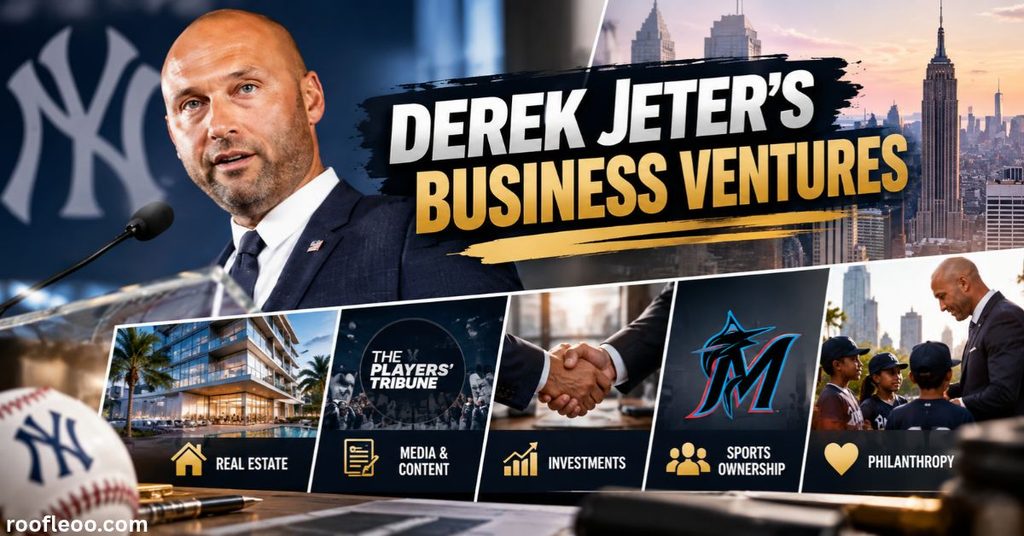
Turn 2 Foundation (1996). He started it with his father during his rookie year. The charity supports young people through programs that promote healthy lifestyles and academic achievement. It has run for 30 years.
Jeter Publishing (2012). This imprint, created with Simon & Schuster, produced children’s books and memoirs.
The Players’ Tribune (2014). Jeter launched this media platform so athletes could tell their stories in their own words. It became a popular home for first-person sports writing. He later sold the company to Minute Media in 2019.
Miami Marlins (2017 to 2022). Jeter joined a group led by Bruce Sherman that bought the Marlins for about $1.2 billion. He served as CEO and held a stake of roughly 4 percent. According to Mantle Magazine’s reporting, he stepped down in February 2022 and sold his stake, valued around $45 million. He had put in roughly $25 million of his own money.
Media and brand work. Since leaving the Marlins he has focused on media projects and brand partnerships rather than team ownership. His endorsement history includes Nike’s Jordan Brand, Gatorade, Ford, Visa, and Movado.
Derek Jeter’s Legacy
In January 2020 the Baseball Hall of Fame announced Jeter’s election. He appeared on 396 of 397 ballots. That works out to 99.7 percent, the second-highest share in history at the time. One voter left him off. Fans still debate who it was.
Beyond the numbers, he set a tone. He avoided scandals during a turbulent era. He stayed polite with the press. He played hard every night. A generation of kids picked No. 2 for their Little League jerseys because of him. You can read his official plaque at the National Baseball Hall of Fame.
Who Is Hiroshi Mikitani?
Hiroshi Mikitani is the founder, chairman, and CEO of Rakuten Group. His company runs one of the largest online marketplaces in Japan. It also operates banking, credit cards, travel booking, mobile service, and more.
Here’s a snapshot:
| Detail | Fact |
|---|---|
| Full name | Hiroshi Mikitani (三木谷 浩史) |
| Born | March 11, 1965, in Kobe, Japan |
| Education | Hitotsubashi University; Harvard Business School (MBA) |
| Company founded | Rakuten, 1997 |
| Title | Chairman and CEO, Rakuten Group |
| Sports holdings | Tohoku Rakuten Golden Eagles; Vissel Kobe |
| Estimated net worth | Roughly $4 billion, per Forbes-based reporting |
Net worth estimates for Mikitani swing widely because Rakuten’s stock price moves a lot. Forbes-based reporting from November 2025 put his fortune near $4.3 billion. Other trackers show higher or lower numbers depending on the day.
Hiroshi Mikitani’s Early Life and Education
Mikitani grew up in Kobe, a port city in western Japan. His father, Ryoichi Mikitani, was an economics professor at Kobe University. Dinner conversations at home often drifted toward trade, markets, and how economies work. That background shaped the way he thought about business.
He enrolled at Hitotsubashi University, one of Japan’s top schools for commerce and economics. After graduating in 1988 he joined the Industrial Bank of Japan. Banking taught him how deals work. It also showed him how slowly large Japanese institutions moved.
Next came a big leap. The bank sent him to Harvard Business School, where he earned an MBA in 1993. He saw how American startups raised money and moved fast. Then he returned to Tokyo with a restless streak.
The Earthquake That Changed His Path
On January 17, 1995, the Great Hanshin earthquake struck Kobe. It killed more than 6,400 people and flattened parts of his hometown. The disaster hit him hard. Mikitani has described it as a turning point. Life, he concluded, is short. He wanted to build something of his own.
He left banking in 1996 and started a consulting firm. A year later it became Rakuten.
Founding Rakuten
Mikitani launched Rakuten in 1997 with a simple idea. The name means “optimism” in Japanese. Its flagship site, Rakuten Ichiba (meaning “marketplace”), opened with just 13 merchants.
Amazon sold its own inventory. Rakuten took a different route. It let small shops open virtual storefronts and keep their own brand identity. Shop owners felt like partners rather than suppliers. That “empowerment” model won loyalty fast.
The company went public in 2000. By the 2010s it had grown into a global group.
Hiroshi Mikitani’s Business Ventures
Rakuten grew through bold acquisitions and big bets:
- Buy.com (2010): a major step into the U.S. market, for roughly $250 million
- Kobo (2011): an e-reader and e-book company based in Canada
- Viber (2014): a messaging app, purchased for about $900 million
- Ebates (2014): a cash-back shopping site, bought for around $1 billion and later rebranded as Rakuten Rewards
- Lyft (2015): a $300 million investment in the ride-hailing company
- Rakuten Mobile (2020): a fourth mobile carrier in Japan, built on a cloud-based network
- Rakuten Bank: a digital bank that listed publicly in 2023
Not every move paid off right away. The mobile network, in particular, cost billions to build. Mikitani accepted heavy losses in exchange for a shot at disrupting Japan’s big three carriers. Critics questioned the spending. Supporters pointed out that he had backed ideas that seemed unlikely before.
Sports Ownership as a Brand Strategy
Mikitani understood early that sports can build trust faster than ads. In 2004, Japan’s pro baseball world went through a shake-up. Two teams merged, and a spot opened for a new franchise. Mikitani seized it. He founded the Tohoku Rakuten Golden Eagles in Sendai, in northern Japan. He also bought the soccer club Vissel Kobe in his hometown.
Rakuten later sponsored global teams. FC Barcelona wore the Rakuten logo on its jersey for several seasons. The Golden State Warriors carried it on their uniforms too. Each deal put the brand in front of hundreds of millions of viewers.
The English-Only Experiment
In 2010 Mikitani announced that English would become Rakuten’s official company language. He called the policy “Englishnization.” Employees had two years to reach a working level of English. Staff meetings, documents, and emails would switch over.
Many people thought he’d lost his mind. Japanese media mocked him. Even so, he pushed ahead. Test scores climbed. Hiring broadened. The company opened doors to global talent.
It also shows his leadership style: he picks a bold direction and commits.
Mikitani’s Legacy
Mikitani stands out as a rare Japanese founder who thinks globally and acts boldly. In 2013, he quit Japan’s powerful business lobby, Keidanren, after a dispute over rules for selling medicine online. Few executives would risk that.
His legacy is still being written. Even so, he already helped redefine what a Japanese tech leader can look like. For more detail, you can visit Rakuten’s corporate site.
The Connection Between Derek Jeter and Hiroshi Mikitani
So how do these two men connect? Through baseball’s global marketplace.
Derek Jeter and Hiroshi Mikitani share one link: Masahiro Tanaka. Mikitani’s company owned the club that developed Tanaka. Jeter’s Yankees signed him. The deal closed in January 2014, just before Jeter’s final season.
Setting the Scene in 2014
To understand the link, you need a little background. For years, Japanese stars reached the majors through the “posting system.” A Japanese club would auction its player to MLB teams. The winning bid, called the posting fee, went to the Japanese team.
The system had flaws. Fees soared. In 2006, the Boston Red Sox paid more than $51 million just for the right to negotiate with Daisuke Matsuzaka. Then they still had to sign him. Critics said MLB teams were overpaying and Japanese clubs were gaming the process.
In late 2013, MLB and Japan’s league agreed to a new deal. It capped the posting fee at $20 million. Any team willing to pay could negotiate with the player. Tanaka became the first big star to test it.
How the Link Works
Here’s the chain in plain terms:
- Mikitani owned the Rakuten Golden Eagles, Tanaka’s team.
- Tanaka became a global sensation after his unbeaten 2013 season.
- Rakuten agreed to post him.
- The Yankees paid the $20 million fee to Rakuten and signed him.
- Jeter, as captain, welcomed him to the clubhouse.
What the Connection Is Not
Here’s where many articles stretch the truth. Jeter did not negotiate with Mikitani. No known business venture links them. No public record shows a private meeting. They are two famous people who sat on opposite sides of one deal.
That said, the transaction was real and significant. It moved tens of millions of dollars across the Pacific. It also moved a franchise player.
A Quick Timeline
| Date | Event |
|---|---|
| 2013 | Tanaka goes 24-0 and leads Rakuten to its first Japan Series title |
| Dec 2013 | New posting system takes effect, with a $20 million fee cap |
| Jan 22, 2014 | Tanaka signs with the Yankees |
| Apr 4, 2014 | Tanaka makes his MLB debut in Toronto and wins |
| Sept 25, 2014 | Jeter hits a walk-off single in his final home game |
| Sept 28, 2014 | Jeter plays his last MLB game |
Masahiro Tanaka: The Key Figure Linking Both Men
Tanaka is the heart of this story. Without him, Derek Jeter and Hiroshi Mikitani would have no shared chapter at all.
The Japan Years
Tanaka debuted as an 18-year-old in 2007 with Rakuten. He grew into an ace. But 2013 turned him into a legend.
That season he won all 24 of his regular-season starts. He posted an ERA near 1.27. He also helped the Golden Eagles reach the Japan Series against the powerful Yomiuri Giants. The series went seven games.
Then came the part fans still talk about. In Game 6, Tanaka threw 160 pitches in a complete-game loss. The next day, he volunteered to close Game 7. He walked to the mound in the ninth inning and sealed the title. As JapanBall’s recap notes, that win remains the Eagles’ first and only Japan Series championship.
For Mikitani, it was a dream. Sendai had endured the 2011 earthquake and tsunami. The team’s win lifted a whole region.
The Posting Decision
Rakuten had a tough choice. Tanaka was the face of the franchise. Losing him would hurt ticket sales and jersey sales. But he wanted a shot at the majors. Mikitani’s team agreed to post him, and Tanaka became available to all 30 MLB clubs.
Rakuten would collect the $20 million fee from whichever team signed him.
The Yankees Deal
On January 22, 2014, Tanaka agreed to a seven-year, $155 million contract with the Yankees. The deal included an opt-out clause after the 2017 season. The Yankees also paid Rakuten the $20 million fee. All told, the investment topped $175 million.
| Deal Component | Amount |
|---|---|
| Contract length | 7 years |
| Contract value | $155 million |
| Posting fee paid to Rakuten | $20 million |
| Total commitment | About $175 million |
| Opt-out | After 2017 (Tanaka stayed) |
Overlap With Jeter
Tanaka debuted on April 4, 2014. He pitched seven innings and struck out eight to win in Toronto. Jeter was in the lineup that day. For one season, the two shared a clubhouse.
That timing mattered. Jeter’s final year meant packed stadiums and constant coverage. Tanaka walked into the biggest media storm in baseball. He finished 13-5 that season and made the All-Star team. A partial elbow tear in July threatened his year, but he avoided surgery and returned in September.
Tanaka’s Path After 2014
His Yankees run lasted seven seasons. He finished 78-46 with a 3.74 ERA. He also became a postseason workhorse.
After 2020 he returned to Japan and rejoined Rakuten. Years later, in late 2024, Rakuten parted ways with him after an injury-hit stretch. He then signed with the Yomiuri Giants, the very team he beat in 2013.
His story keeps going. He reached his 200th career win in April 2025, counting 119 with Rakuten, 78 with New York, and three with Yomiuri. By spring 2026, Kyodo News coverage showed him tying former Yankees teammate Hiroki Kuroda with a 203rd career win. Through mid-June 2026, Pacific League reports listed a 3-2 record and 2.79 ERA across nine games.
Comparing Their Careers and Achievements
One man built his fame on a baseball diamond. The other built his on a screen. Still, the two share more than you might expect.
Side-by-Side Table
| Category | Derek Jeter | Hiroshi Mikitani |
|---|---|---|
| Born | 1974, Pequannock, New Jersey | 1965, Kobe, Japan |
| Field | Baseball, then business | Technology and e-commerce |
| Signature achievement | 5 World Series titles; 3,465 hits | Founding Rakuten in 1997 |
| Education | High school; drafted in 1992 | Hitotsubashi University; Harvard MBA |
| Business ventures | Players’ Tribune; Jeter Publishing; Marlins CEO | Rakuten Ichiba; Rakuten Mobile; Rakuten Bank; Viber; Ebates |
| Sports link | Yankees captain; former Marlins CEO | Owner of Golden Eagles and Vissel Kobe |
| Philanthropy | Turn 2 Foundation (since 1996) | Rakuten Foundation and education programs |
| Public image | Clean-cut, clutch, quietly private | Bold, outspoken, globally minded |
| Estimated net worth | About $200 million | Roughly $4 billion |
| Defining legacy | The model captain of a dynasty | A Japanese tech pioneer with global reach |
What They Share
Both men built brands that reach well beyond their home markets. Jeter’s face sells watches, drinks, and sneakers worldwide. Mikitani’s company logo appears on soccer jerseys in Europe.
They also share discipline. Jeter’s parents wrote him a contract for success. Mikitani walked away from a safe banking career and bet on himself.
Third, both show a global mindset. Jeter became a hero in Japan during the Yankees’ era of Japanese stars. Mikitani made English a company rule.
Where They Differ
The differences stand out too. Jeter’s fame came from consistent performance in a team sport. Mikitani’s wealth came from building and leading a corporation. Jeter’s net worth is a fraction of Mikitani’s, though Jeter ranks among the wealthiest retired baseball players.
Their styles clash as well. Jeter rarely said anything controversial. Mikitani, by contrast, picks public fights, from the Keidanren walkout to the English-only mandate. One is a careful diplomat. The other is a disruptor.
Case Study: Two Ways to Build a Brand
Jeter’s approach: Stay consistent and let results speak. He avoided scandal for two decades. That reputation later helped him land endorsements and executive roles.
Mikitani’s approach: Make noise and take risks. He bought sports teams to boost awareness. He sponsored top European clubs. He accepted short-term losses to build long-term recognition.
Neither approach is wrong. Together, they show how different paths lead to influence.
Why Their Connection Matters
At first glance, a pitcher changing teams looks like routine sports business. But this transaction told a bigger story.
Baseball Became a Two-Way Street
For decades, MLB teams mined Japan for talent. Hideo Nomo opened that door in 1995. Ichiro and Hideki Matsui walked through it. By 2014, Japanese players were fixtures.
Tanaka’s move showed how much money flowed across the Pacific. It also highlighted how much leverage Japanese owners like Mikitani held. They weren’t just selling players. They were negotiating partnerships.
Brand Reach on Both Sides
For the Yankees, Tanaka expanded their audience in Japan. Broadcasts reached millions of new viewers. Merchandise sold in Tokyo and Osaka.
For Rakuten, the deal raised visibility in the U.S. The company was working to push Rakuten Rewards and other American services. The name appeared in headlines about one of the biggest signings of the winter.
A Bridge With Two Anchors
Think of Tanaka as a suspension bridge. Mikitani stood at one tower in Sendai. Jeter stood at the other in the Bronx. Neither man built the whole structure alone. Yet traffic only flowed because both ends held firm.
That image helps explain why this story resonates. It’s not about two men who met. It’s about two systems that connected.
The Broader Impact of the 2014 Transfer
Tanaka’s move left a footprint that stretches well past one season.
Changes to the Posting System
The $20 million cap, introduced during the Tanaka era, changed the economics. Japanese teams lost the chance to collect $50 million or more. Some owners complained. Players, meanwhile, gained more freedom to pick their destination.
Later updates shifted the formula again. Fees now tie to the size of the contract. Still, the 2014 version set the template.
A Pipeline of Japanese Talent
Tanaka’s success helped pave the way for the next wave. Shohei Ohtani, Yu Darvish, Yoshinobu Yamamoto, and others followed. Each signing brought sponsors, translators, and international media along.
Teams started staffing Japan-based scouts and building Japanese-language social media accounts. The 2014 deal marked a turning point in how clubs approached the market.
Business Effects
Here’s a quick look at where the money moved:
- Media rights: Japanese broadcasters paid more to show Yankees games.
- Merchandise: Tanaka jerseys and Yankees caps sold in huge volumes in Japan.
- Sponsorship: Japanese brands bought stadium signage and team deals.
- Tourism: Fans traveled from Japan to see games in New York.
Cultural Impact
Japanese fans began following MLB with new intensity. Early morning broadcasts became a ritual. In New York, fans embraced Tanaka quickly. They cheered his split-finger fastball and his calm presence.
The effect ran both ways. Yankees traditions, from the Jeter farewell to Old-Timers’ Day, gained new viewers in Asia.
Tanaka’s Return and the Loop Closes
After his Yankees years, Tanaka returned to Rakuten. He helped restore pride in Sendai. When his time there ended, he moved to Tokyo’s Giants. Even now he keeps pitching at 37, adding wins to a combined total that places him among the most successful pitchers to work on both sides of the ocean.
It’s a fitting epilogue. The man who linked Derek Jeter and Hiroshi Mikitani is still writing his own chapter.
Frequently Asked Questions
Did Derek Jeter and Hiroshi Mikitani ever meet?
No public record confirms a meeting or a business relationship. Their only documented link runs through Masahiro Tanaka’s 2014 move from Rakuten to the Yankees. If you come across a claim of a personal tie, look for a primary source before sharing it.
What connects Derek Jeter and Hiroshi Mikitani?
Masahiro Tanaka connects them. Mikitani’s Rakuten Golden Eagles developed him. Jeter’s Yankees signed him in January 2014. The two men sit on opposite ends of that transfer.
Did Hiroshi Mikitani own the team that Tanaka played for?
Yes. Mikitani founded the Tohoku Rakuten Golden Eagles in 2004 through his company. Tanaka pitched for them from 2007 to 2013 and again from 2021 to 2024.
How much did the Yankees pay for Masahiro Tanaka?
The Yankees signed Tanaka to a seven-year, $155 million contract. They also paid a $20 million posting fee to Rakuten. That brought the total commitment to roughly $175 million.
How many World Series titles did Derek Jeter win?
Jeter won five World Series titles, all with the Yankees. They came in 1996, 1998, 1999, 2000, and 2009.
What made Derek Jeter famous?
Jeter earned fame as the Yankees’ longtime shortstop and captain. He collected 3,465 hits, won five championships, and built a reputation for clutch moments. His 2020 Hall of Fame vote of 99.7 percent sealed his status.
What is Hiroshi Mikitani best known for?
Mikitani is best known for founding Rakuten, a major Japanese e-commerce and fintech group. He also owns top Japanese sports teams and pushed an English-only policy at his company. His bold, risk-friendly style sets him apart.
Conclusion
Two men. Two industries. One pitcher.
Derek Jeter and Hiroshi Mikitani came from different worlds. Jeter rose through Michigan ball fields and Yankee Stadium’s famous infield. Mikitani climbed out of Kobe’s banking offices and into Tokyo’s tech scene. Their only shared chapter came in the winter of 2014, when Masahiro Tanaka crossed the Pacific.
Yet that chapter reveals a lot. It shows how global baseball has become. It also proves that a single transaction can expose larger forces, from posting rules to brand strategy. Jeter and Mikitani each used sports to build influence. Each did it in his own way.
So what do you think? Was the Tanaka deal a win for the Yankees, for Rakuten, or for both? Share your take in the comments. And if you enjoyed this deep dive, check out our related guides on Japanese stars in MLB and Rakuten’s business model.

