

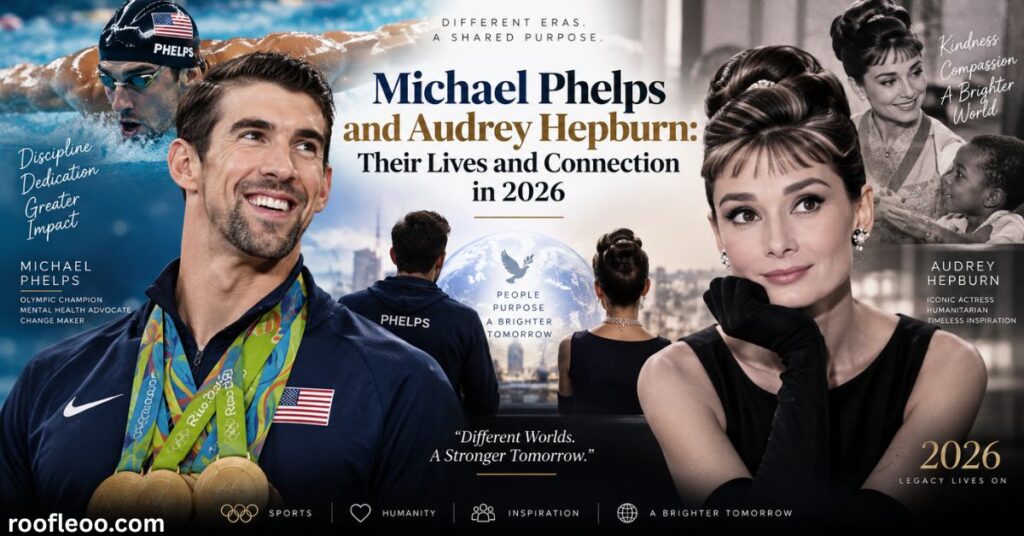
Every so often, the internet throws up a pairing that makes you tilt your head and ask, “Wait, how are these two connected?” Michael Phelps and Audrey Hepburn is one of those pairings. One is the most decorated Olympian in history. The other is a Hollywood legend remembered for her elegance and her humanitarian work. On paper, they don’t share a decade, a country, or a profession.
And yet, search engines light up with questions about audrey hepburn and michael phelps almost every year. So what’s actually going on here? Are they related? Did their paths ever cross? And why do people keep putting these two names in the same sentence?
This article digs into all of it. You’ll get the full story on both icons, an honest answer about their connection (or lack of one), and a side-by-side look at what actually links them: not blood, not a shared project, but something a little more interesting.
Michael Phelps and Audrey Hepburn: Quick Comparison
Before we go deep, here’s a snapshot that lays out both lives at a glance.
| Category | Michael Phelps | Audrey Hepburn |
|---|---|---|
| Born | June 30, 1985, Baltimore, Maryland | May 4, 1929, Ixelles, Belgium |
| Died | Still living (age 41 in 2026) | January 20, 1993 (age 63) |
| Profession | Competitive swimmer | Actress, fashion icon, humanitarian |
| Nationality | American | British-Belgian (Dutch upbringing) |
| Known For | 23 Olympic gold medals, 28 total | Roman Holiday, Breakfast at Tiffany’s, My Fair Lady |
| Major Honors | Most decorated Olympian in history | Academy Award, Presidential Medal of Freedom |
| Legacy Work | Mental health advocacy, Michael Phelps Foundation | UNICEF Goodwill Ambassador |
| Era of Peak Fame | 2000s–2010s | 1950s–1960s |
Even from this table, one thing jumps out: these are two people who reached the very top of completely different mountains. That’s actually the heart of why people find them worth comparing.
Are Michael Phelps and Audrey Hepburn Related?
Let’s answer this one directly: no, Michael Phelps and Audrey Hepburn are not related. There’s no documented family connection, no shared ancestry, and no genealogical link between them.
Phelps was born and raised in Baltimore, Maryland, to an American family with no ties to Belgium or the Netherlands, where Hepburn spent much of her early life. Hepburn’s family background traces to British and Dutch nobility on her mother’s side, while her father was English. Phelps’s family history, by contrast, is rooted in working- and middle-class American life, with his mother working as a school principal and his father as a state trooper.
So where does the “related” question even come from? A few likely explanations:
- Trivia and quiz sites sometimes pair unrelated celebrities to test how well readers know pop culture history.
- Search algorithms notice that people search both names close together and start suggesting the pairing automatically.
- Visual comparison content, like “spot the resemblance” posts, occasionally puts unrelated public figures side by side.
None of that amounts to an actual family tie. It’s curiosity, not genealogy, driving the question.
Did Michael Phelps Ever Meet Audrey Hepburn?
This is where the timeline makes things pretty clear-cut. Audrey Hepburn passed away in January 1993. Michael Phelps was born in June 1985, which means he was only seven years old when she died. He hadn’t even started competitive swimming yet — that came a year or two later, around age seven to eight, at a local swim club in Maryland.
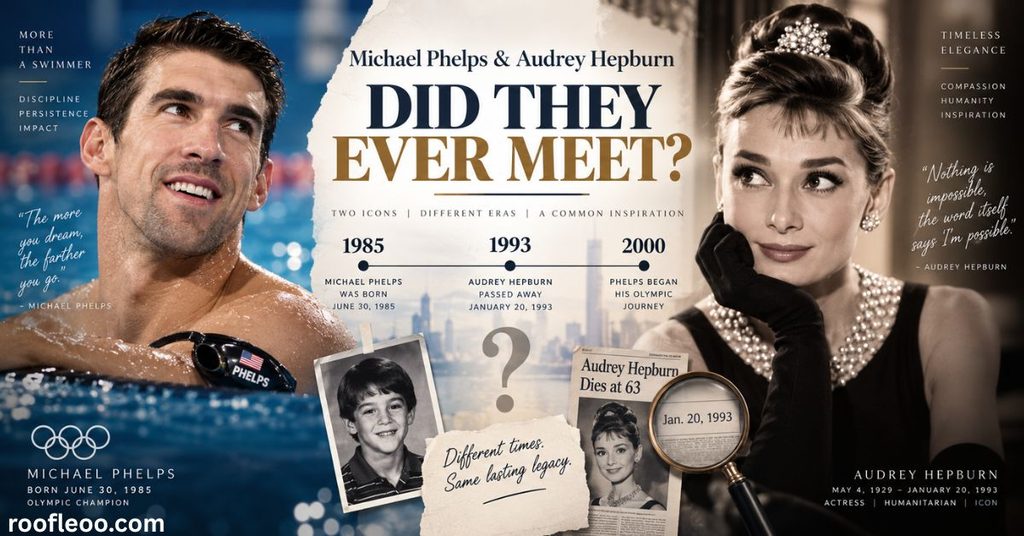
There’s no public record, photo, interview, or anecdote suggesting the two ever met, corresponded, or crossed paths in any way. Their adult lives never overlapped: Hepburn’s public career wound down through the late 1980s as she focused on humanitarian work, and Phelps didn’t become a household name until the Sydney Olympics in 2000, seven years after her death.
So why do people still ask? Mostly because the question “did X meet Y” is one of the most common searches attached to any pair of famous names, whether or not the timeline makes sense. It’s a natural human instinct to wonder about crossovers between icons, even icons from entirely different eras.
Who Was Audrey Hepburn?
Audrey Hepburn’s story starts long before Hollywood. Born in Belgium in 1929, she spent part of her childhood in England before her family moved to the Netherlands, where she lived through the German occupation during World War II. Those war years were formative and difficult, marked by food shortages and the constant fear that comes with occupation. Some biographers have pointed to that period as the root of her lifelong sensitivity toward children suffering from war and poverty, a thread that would define the second half of her life.
After the war, Hepburn trained as a ballet dancer before pivoting toward acting. Her breakout role came in 1953 with Roman Holiday, where she played a runaway princess opposite Gregory Peck. The role won her an Academy Award for Best Actress and instantly made her one of the most sought-after actresses in the world.
From there, her filmography reads like a highlight reel of mid-century cinema:
- Sabrina (1954)
- Funny Face (1957)
- Breakfast at Tiffany’s (1961)
- Charade (1963)
- My Fair Lady (1964)
Beyond acting, Hepburn became a defining style icon of the 20th century. Her partnership with fashion designer Hubert de Givenchy shaped the “little black dress” aesthetic that’s still referenced by designers today. She wasn’t just wearing fashion; she was setting the template for it.
Audrey Hepburn and UNICEF
By the late 1980s, Hepburn had mostly stepped back from acting and shifted her focus to humanitarian work. In 1988, she became a UNICEF Goodwill Ambassador, a role she took seriously in a way that went far beyond ceremonial appearances.
Over the following years, she traveled to some of the most difficult places on earth:
- Ethiopia (1988) — visiting famine relief programs
- Turkey (1988) — supporting a nationwide vaccination campaign
- Venezuela and Ecuador (1988) — assessing child welfare programs
- Bangladesh (1989) — reviewing education and health initiatives
- Sudan (1989) — during Operation Lifeline Sudan, a major humanitarian relief effort
- Vietnam (1990) — focused on water sanitation projects
- Somalia (1992) — just months before her death, during a severe famine crisis
She often described these trips not as photo opportunities but as necessary bearing witness. In interviews, she pushed back on the idea that fame should be wasted on vanity when it could bring attention to children who had no voice of their own.
“I can testify to what UNICEF means to children, because I was among those who received food and medical relief right after World War II.” — Audrey Hepburn
For this work, she received the Presidential Medal of Freedom in December 1992, one of the highest civilian honors in the United States, and was awarded it again posthumously in 1993 shortly after her death. Her humanitarian legacy is arguably why her name still carries weight decades after her final film.
Who Is Michael Phelps?
Michael Phelps was born on June 30, 1985, in Baltimore, Maryland. As a kid, he had a lot of restless energy, and swimming became the outlet that channeled it. He started training under coach Bob Bowman at age eleven, a partnership that would define the next two decades of his life.
Phelps qualified for his first Olympics at the 2000 Sydney Games when he was just 15 years old, making him the youngest male to make a U.S. Olympic swim team in 68 years. He didn’t medal that year, but it set the stage for what came next.
By the time he retired in 2016, Phelps had racked up numbers that redefined what was thought possible in the sport:
| Olympic Games | Gold Medals | Total Medals |
|---|---|---|
| Sydney 2000 | 0 | 0 |
| Athens 2004 | 6 | 8 |
| Beijing 2008 | 8 | 8 |
| London 2012 | 4 | 6 |
| Rio 2016 | 5 | 6 |
| Career Total | 23 | 28 |
That 28-medal career total makes him the most decorated Olympian of all time, across any sport, by a wide margin. The next closest athlete isn’t even in the same neighborhood.
Phelps and the 2008 Beijing Olympics
If there’s one moment that turned Phelps from “elite swimmer” into a global name, it’s Beijing 2008. He won eight gold medals in a single Olympics, breaking the previous record of seven set by Mark Spitz in 1972. Seven of those eight races were won by less than a second, and one — the 4x100m freestyle relay — came down to a finish so close it needed a photo review to confirm.
That performance turned Phelps into a genuine crossover star. He wasn’t just known in swimming circles anymore; he was on magazine covers, in Olympic commercials, and recognized in countries where swimming barely registers as a spectator sport. It’s a similar kind of “instant global recognition” moment to what Hepburn experienced after Roman Holiday, just decades apart and in a completely different arena.
After Beijing, Phelps competed in two more Olympic cycles before retiring in 2016. In the years since, he’s become an outspoken advocate for mental health, openly discussing his own struggles with depression and anxiety after the pressure of competition faded. That advocacy work, through interviews, documentaries, and his foundation, has become as much a part of his public identity as his medal count.
What Do Michael Phelps and Audrey Hepburn Have in Common?
Here’s where the comparison actually starts to make sense. Strip away the decades and the professions, and a few real similarities emerge.
They became global names
Both Phelps and Hepburn reached a level of fame that transcended their industries. You didn’t need to follow competitive swimming to know who Michael Phelps was after 2008, just like you didn’t need to be a film buff to recognize Audrey Hepburn’s image in the 1960s. Their names became shorthand for excellence in their respective fields, recognized well outside their core audiences.
They achieved exceptional success
This one doesn’t need much explanation, but it’s worth putting the numbers side by side:
- Phelps holds 23 Olympic gold medals, a record that experts widely consider close to unbreakable given the physical demands of competing across multiple Games.
- Hepburn won an Academy Award, a Tony Award, and a Grammy Award (for a spoken-word recording), putting her in rare company among entertainers who’ve achieved recognition across multiple mediums.
Both represent a kind of ceiling-breaking excellence that’s rare even among famous people. They weren’t just successful. They were the benchmark others got measured against.
Their legacies extend beyond their original professions
This might be the strongest link between them. Hepburn is remembered today almost as much for her UNICEF work as for her films. Ask someone what they know about her, and “humanitarian” comes up nearly as often as “actress.”
Phelps has followed a similar arc. His post-retirement identity leans heavily on mental health advocacy, and his foundation focuses on water safety and swim education for children who might never compete athletically but deserve to be safe in the water. Neither figure was content to let their original claim to fame be the whole story.
The Biggest Difference Between Their Stories
For all the overlap, one core difference separates Phelps and Hepburn’s stories: the nature of their fame itself.
Hepburn’s stardom was built on narrative, image, and cultural moment. Film is subjective; you can debate who the “greatest actress” of a generation is, and reasonable people will land on different answers. Her fame was also deeply tied to a specific era of Hollywood glamour and postwar European sensibility that shaped how audiences saw her.
Phelps’s fame, on the other hand, is built on something almost brutally objective: time on a stopwatch. There’s no debate about who won a race by three-hundredths of a second. His greatness is measurable, repeatable, and recorded in a way that film performances simply aren’t.
That difference matters because it shapes how each of them is remembered. Hepburn’s legacy lives in cultural memory, cinema history, and evolving audience appreciation. Phelps’s legacy lives in a record book that’s unlikely to be rewritten anytime soon.
Why Do People Search for Michael Phelps and Audrey Hepburn Together?
So if they’re not related and never met, why does audrey hepburn and michael phelps keep showing up as a search term? A few realistic reasons:
- “Most iconic figures of the 20th/21st century” lists frequently include both names, which trains search engines to associate them.
- Trivia games and quiz apps love pairing unlikely names to test general knowledge.
- Curiosity about eras colliding — people are naturally drawn to “what if” questions about figures from different generations.
- Content aggregation and SEO patterns, where articles comparing random celebrity pairs generate search interest simply because the pairing feels unexpected.
There’s also a simpler explanation: sometimes a name search autocompletes into an odd pairing because of shared initials, similar-sounding surnames in unrelated contexts, or algorithmic suggestion quirks. It doesn’t always take a deep cultural reason. Sometimes curiosity is its own reason.
A Timeline Makes the Difference Clear
Seeing both lives laid out side by side really drives home how separate their stories are.
| Year | Event |
|---|---|
| 1929 | Audrey Hepburn born in Belgium |
| 1953 | Hepburn wins Academy Award for Roman Holiday |
| 1961 | Breakfast at Tiffany’s releases, cementing her style-icon status |
| 1964 | My Fair Lady releases |
| 1985 | Michael Phelps born in Baltimore |
| 1988 | Hepburn becomes UNICEF Goodwill Ambassador |
| 1992 | Hepburn visits Somalia during famine relief efforts |
| 1993 | Hepburn passes away; Phelps is 7 years old |
| 2000 | Phelps makes his Olympic debut in Sydney |
| 2004 | Phelps wins 6 golds in Athens |
| 2008 | Phelps wins a record 8 golds in Beijing |
| 2016 | Phelps competes in his final Olympics in Rio |
| 2026 | Both remain cultural touchstones, decades apart |
Looking at this, there isn’t a single year where their active public lives overlap in any meaningful way. Hepburn’s public life was winding down right as Phelps’s was just beginning.
What Made Both Figures Memorable?
Strip away the specifics of swimming and cinema, and you’re left with two people who mastered the art of being unforgettable, just through very different means.
Hepburn’s staying power comes from a combination of things: her distinctive look, her understated acting style that felt more natural than theatrical for her era, and the genuine warmth people sensed in her humanitarian work. She wasn’t performing kindness for cameras; the accounts from UNICEF staff who traveled with her describe someone who was visibly moved by what she witnessed, not just going through diplomatic motions.
Phelps’s staying power comes from raw, visible excellence. There’s something almost primal about watching someone do a physical thing better than any human being in recorded history. His later openness about mental health struggles added a layer of relatability that pure athletic dominance doesn’t provide on its own. People didn’t just admire him for winning; they respected him for being honest about what winning cost him.
Both, in their own ways, mastered a rare trick: they made extraordinary things feel human.
Frequently Asked Questions
Are Michael Phelps and Audrey Hepburn related?
No. There is no documented family or genealogical connection between Michael Phelps and Audrey Hepburn. Their family backgrounds, nationalities, and personal histories don’t intersect in any known way.
Did Michael Phelps meet Audrey Hepburn?
No public record indicates the two ever met. Hepburn passed away in 1993, when Phelps was only seven years old and hadn’t yet begun competitive swimming.
Did Michael Phelps and Audrey Hepburn work together?
No. They never collaborated on any project, campaign, or public appearance. Their careers didn’t overlap in time or industry.
How old was Michael Phelps when Audrey Hepburn died?
Phelps was seven years old when Hepburn passed away in January 1993, since he was born in June 1985.
What was Audrey Hepburn best known for?
Hepburn is best known for iconic film roles in Roman Holiday, Breakfast at Tiffany’s, and My Fair Lady, as well as her later humanitarian work as a UNICEF Goodwill Ambassador.
How many Olympic medals did Michael Phelps win?
Phelps won 28 total Olympic medals, including 23 gold, making him the most decorated Olympian in history.
Did Audrey Hepburn work with UNICEF?
Yes. Hepburn served as a UNICEF Goodwill Ambassador from 1988 until her death in 1993, traveling to countries including Ethiopia, Sudan, Bangladesh, Vietnam, and Somalia to support children’s welfare programs.
What is Michael Phelps best known for?
Phelps is best known for his Olympic swimming career, particularly his record-setting eight gold medals at the 2008 Beijing Olympics, along with his advocacy for mental health awareness after retiring.
Final Thoughts
At the end of the day, audrey hepburn and michael phelps isn’t a story about hidden family ties or secret meetings. It’s a story about two people, born decades apart, who each reached the absolute top of their fields and then chose to use that platform for something bigger than themselves.
Hepburn traded Hollywood glamour for humanitarian fieldwork in some of the hardest places on earth. Phelps traded the pool for open conversations about mental health that have genuinely helped shift public perception. Neither needed to do that. Both did it anyway.
Maybe that’s the real reason their names keep getting searched together. Not because their stories overlap, but because they both prove the same point: real legacy isn’t just about how good you were at the thing that made you famous. It’s about what you did with the attention once you had it.

