

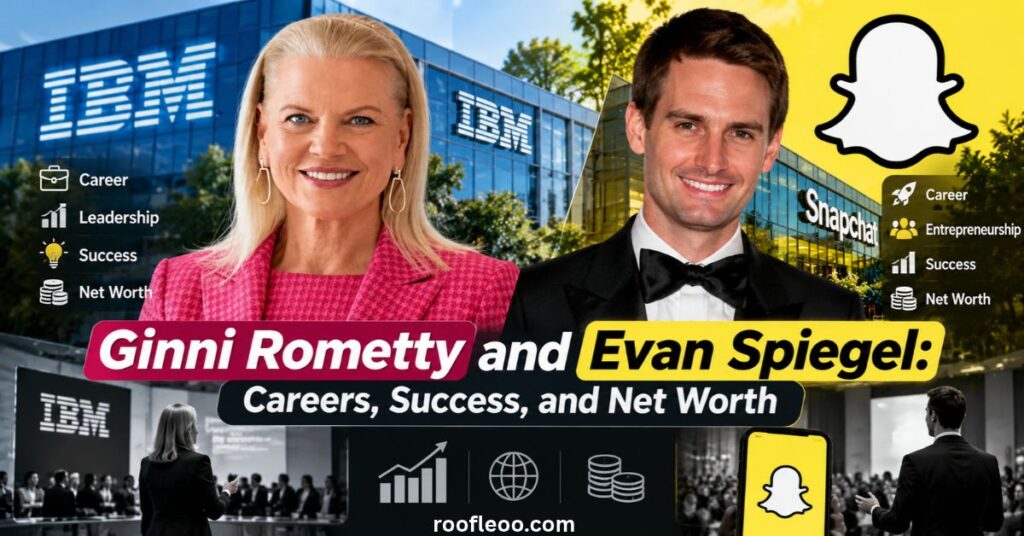
What do a 40-year corporate climber and a Stanford dropout have in common? More than you’d think. Both took on giants. Both bet big on technology that most people didn’t understand yet. And both left a mark on the industry that’s hard to ignore.
This guide looks at ginni rometty and evan spiegel side by side. You’ll see how they built their careers, what they earned, how they led, and what you can borrow from their playbooks. Grab a coffee. It’s a good story.
Who Is Ginni Rometty?
Ginni Rometty built her legacy by outlasting doubt. She became the first woman to run IBM, one of the oldest and most famous technology companies on the planet. Getting there took decades of hard, steady work.
Early Life and Education
Virginia “Ginni” Rometty was born on July 29, 1957, in Chicago, Illinois. Her father left the family when she was a teenager. Her mother then raised four children on her own and worked several jobs to keep the household afloat.
Rometty has often pointed to that period as her best teacher. Watching her mother push through hardship shaped her grit. It also shaped her belief that you can’t wait for a perfect moment to move forward.
She studied at Northwestern University and earned a degree in computer science and electrical engineering. A scholarship helped pay her way. Few women filled those classrooms at the time, so she learned early how it feels to be the only person like you in the room.
“Growth and comfort do not coexist.”
— Ginni Rometty
That line sums up her whole approach to work.
Climbing the Ranks at IBM
Rometty joined IBM in 1981 as a systems engineer. She didn’t start at the top. She started at the bottom and earned each promotion.
Over the next three decades she moved through several areas:
- Systems engineering: She learned the technical side of the business.
- Consulting: She worked directly with large clients.
- Sales and marketing: She learned what customers wanted and how to sell it.
- Strategy: She helped shape where IBM would invest next.
One moment stands out. After IBM bought the consulting arm of PricewaterhouseCoopers in 2002, Rometty led the integration. Merging two huge cultures is messy work. She made it succeed, and leaders across IBM noticed. That win helped push her toward the corner office.
Ginni Rometty Net Worth
Many readers search for the Ginni Rometty net worth figure. Here’s the honest picture. She doesn’t publish her finances, so public numbers are estimates. Those estimates draw on her IBM pay, stock awards, and investments built over a career that lasted nearly four decades.
Most published estimates put her wealth in the tens of millions of dollars, with many landing somewhere between $50 million and $100 million. During her time as CEO, IBM’s yearly pay disclosures showed total compensation packages that reached well into the double-digit millions in several years. A large share came as stock awards that depended on performance targets.
| Item | What It Means |
|---|---|
| Career length at IBM | About 39 years (1981–2020) |
| Main income sources | Salary, bonuses, stock awards, retirement benefits |
| Estimated net worth | Roughly $50 million to $100 million (estimates vary) |
| Other ventures | Board seats, speaking, book royalties, advisory work |
Compare that with the wealth of founders, and you’ll notice a big gap. Corporate executives earn well. Founders who own shares in a booming company can earn far more. We’ll see that when we reach Spiegel.
Ginni Rometty Leadership at IBM
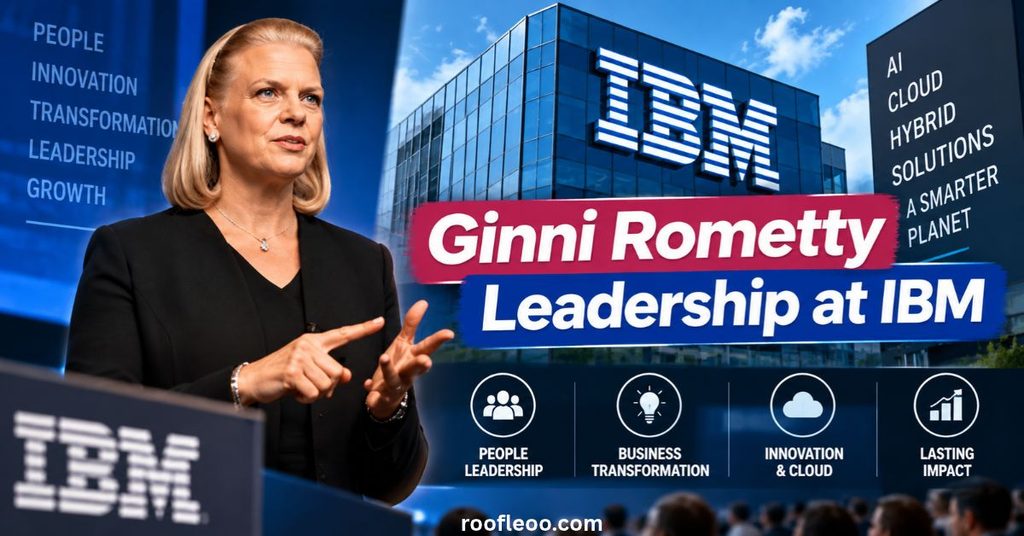
Taking the top job at IBM wasn’t a victory lap. It was a stress test. Rometty inherited a legendary company that had to reinvent itself again.
Becoming CEO and Chairman
Rometty became IBM’s CEO on January 1, 2012. She succeeded Sam Palmisano and made history as the first woman to lead the company. She also took the chairman title later that year.
She held the CEO job for about eight years. In April 2020 she handed the role to Arvind Krishna. She stayed on as executive chairman until the end of 2020 to help with the transition.
The Bet on Cloud, AI, and Watson
Rometty made a clear call. IBM would move toward cloud computing, data analytics, security, and artificial intelligence. Old businesses like hardware and legacy services were slowing down. New ones had to take their place.
Watson became the face of this push. The system had won the quiz show Jeopardy! in 2011, and the public loved it. Turning that fame into steady revenue proved much harder. Watson’s health-care products, for example, struggled to meet the high hopes set for them.
Here’s the fair read on her tenure:
- The good: IBM invested early in AI and cloud and pushed the company into newer markets.
- The tough: Revenue shrank during the transition, falling from over $100 billion in 2011 to roughly $77 billion by 2019.
- The reality: Reinventing a giant takes years. Some of her moves paid off after she left.
The Red Hat Acquisition
If one deal defines her time at IBM, it’s this one.
Case study: IBM and Red Hat
In 2018, IBM announced it would buy open-source software company Red Hat for about $34 billion. The deal closed in 2019. It ranked among the largest software acquisitions in history.
Why did it matter? Red Hat’s technology helps companies run applications across many clouds, not just one. That fits the hybrid cloud strategy Rometty championed. Customers could keep some systems in their own data centers and use public clouds for the rest.
Today IBM still describes hybrid cloud and AI as its core focus. Rometty set that direction, and her successor built on it.
Beyond IBM
Her work didn’t stop at retirement. Rometty co-chaired OneTen, a coalition that aims to help Black talent without four-year degrees land good jobs. The group set a goal of one million careers over ten years.
She also pushed the idea of “new collar” jobs. These roles demand real tech skills but don’t always demand a college degree. Many employers now follow similar skills-first hiring. In 2022 she published her book, Good Power, which looks at leading with purpose.
Who Is Evan Spiegel?
Now flip the script. Evan Spiegel never climbed a corporate ladder. He built his own building.
Early Life and Education
Evan Spiegel was born on June 4, 1990, in Los Angeles, California. His parents were both attorneys, and he grew up in a comfortable home. He attended the Crossroads School in Santa Monica before heading north to Stanford University.
At Stanford he studied product design. He also joined a fraternity where he met Bobby Murphy, who later became his co-founder. Spiegel left school shortly before graduating to work on his startup full time. He did finish later and received his degree in 2018.
From Class Project to Company
The idea began as a class assignment. Spiegel and his friends imagined an app where photos would vanish after you sent them. The early version carried the name Picaboo. It didn’t take off right away.
The team rebranded it as Snapchat, and the app launched in September 2011. Spiegel, Murphy, and early partner Reggie Brown shaped the first version. By the next year, teens had started using it in big numbers.
Evan Spiegel Net Worth
Evan Spiegel net worth tells a very different story from Rometty’s. His fortune rests mostly on his ownership of Snap shares. So it rises and falls with the stock.
Business publications have placed his wealth at roughly $2 billion to $3 billion in recent years, with swings as the share price moves. In a hot market his figure jumps. In a rough year it drops by hundreds of millions.
| Year | Event | Effect on Fortune |
|---|---|---|
| 2013 | Turned down Facebook’s reported $3 billion offer | Kept his stake intact |
| 2017 | Snap goes public at $17 per share | Became a billionaire many times over |
| 2021 | Stock peaks near all-time highs | Wealth reaches its high point |
| 2022 | Stock tumbles after ad revenue slows | Large paper losses |
| Recent years | Stock recovers partly, then moves with the market | Fortune in the low billions |
He married model Miranda Kerr in 2017, and the couple has children. Outside work, he and Kerr have supported various charitable efforts.
Evan Spiegel and the Growth of Snapchat
Evan Spiegel Snapchat success rests on one big insight. Young people wanted a place to be themselves without leaving a permanent record.
The Disappearing Message Idea
Most social apps in 2011 pushed you to post, collect likes, and build a lasting profile. Snapchat flipped that. Messages vanished. Mistakes didn’t haunt you. Silly photos stayed silly.
That small twist made the app feel relaxed. It felt like talking with a friend instead of performing for a crowd. Teens loved it.
Key Milestones
Snapchat’s rise didn’t follow a straight line. Here are the big moments:
| Year | Milestone |
|---|---|
| 2011 | Snapchat launches |
| 2013 | Stories debuts; Spiegel rejects Facebook’s reported $3 billion offer |
| 2015 | Discover launches; Snap buys Looksery, the tech behind Lenses |
| 2016 | Company renames itself Snap Inc. and announces Spectacles |
| 2017 | Snap goes public on the New York Stock Exchange at $17 per share |
| 2017 | Snap Map arrives |
| 2020 | Spotlight launches to compete with short-video rivals |
| 2022 | Snapchat+ subscription debuts |
Stories deserves special attention. Snapchat introduced the format of short posts that last 24 hours. Rivals later copied it across Instagram, Facebook, WhatsApp, and more. Copying is flattering, though it also hurt Snap’s growth.
Spiegel also held tight control. Snap’s public shares came without voting rights. That structure let Spiegel and Murphy keep control of the company after the IPO. Investors grumbled, but it gave him room to chase long-term bets.
Struggles and Pushback
Not every chapter looked bright. Consider these hurdles:
- Copycats: Larger platforms borrowed Snapchat’s best features.
- The 2018 redesign: Users disliked the new layout. A tweet from a celebrity reportedly knocked more than a billion dollars off the company’s market value in a day.
- Privacy changes: Apple’s tracking rules in 2021 hit Snap’s ad business hard.
- Stock swings: Shares fell far below their highs, then partly recovered.
Still, the numbers show a lasting business. Snapchat now reaches more than 450 million people every day, and its monthly audience approaches a billion. Subscriptions through Snapchat+ add a new revenue stream beyond ads.
Evan Spiegel Interest in Augmented Reality

Spiegel doesn’t see Snap as a social network. He sees a camera company. Snap’s 2017 IPO filing described it that way, and he has stuck with the idea ever since.
Why AR Fits His Vision
Think about how people use Snapchat. They open the camera first. Not a feed. That habit gave Snap a perfect launch pad for augmented reality, or AR. AR layers digital objects on top of the real world.
Lenses started as silly face filters. Dog ears. Rainbow tongues. Yet they trained hundreds of millions of people to use AR without thinking about it. Snap says huge numbers of users play with AR every day. Brands now use Lenses to let shoppers try on sunglasses, shoes, and makeup from home.
Spectacles and the Road to Consumer Glasses
Spiegel wanted AR to leave the phone. So in 2016 Snap released Spectacles, sunglasses with a built-in camera. The first version sold as a quirky gadget. It didn’t become a mass hit.
Snap kept iterating:
- 2016: First Spectacles record short video clips.
- 2021: Snap shows AR-ready Spectacles to creators and developers.
- 2024: A fifth-generation developer version arrives with true AR displays.
- 2026: Snap has said it plans a consumer version called Specs.
Check Snap’s latest announcements for the current launch status, since hardware timelines shift often.
Why It’s a Big Bet
Hardware is hard. Software companies stumble when they try it. Snap also faces rivals with far deeper pockets, including Meta, Apple, and Google. All three want to own the next computing device.
Even so, Spiegel believes glasses will replace the phone someday. He’s willing to spend years proving it. The reward could be huge. The risk is just as real.
Ginni Rometty and Evan Spiegel: Comparing Their Leadership Styles
Put ginni rometty and evan spiegel in the same room and you’d see two distinct styles. Yet beneath the differences you’d spot a shared streak of boldness.
Two Very Different Paths
Rometty rose through one institution over nearly 40 years. She learned its culture, earned trust, and then reshaped it from inside. Her style leans toward collaboration, consensus, and careful change.
Spiegel built his company from a dorm-room idea. He set the culture from day one. His style leans toward strong vision, tight control, and bold product bets.
Side-by-Side Comparison
| Category | Ginni Rometty | Evan Spiegel |
|---|---|---|
| Background | Engineer turned executive | Product designer turned founder |
| Path to the top | Promoted from within | Created the company |
| Decision style | Collaborative, strategic | Visionary, design-driven |
| Risk approach | Large acquisitions and long transitions | Rejecting offers, betting on new hardware |
| Talent focus | Skills-based hiring, inclusion | Creative, engineering-led teams |
| Control | Answered to a board and shareholders | Holds voting control through share structure |
| Signature move | The $34 billion Red Hat deal | Stories and AR Lenses |
Where Their Approaches Overlap
Despite the gaps, a few traits connect them:
- Long-term thinking: Both took heat from investors while waiting for bets to pay off.
- Early tech bets: Rometty backed AI and cloud. Spiegel backed AR.
- Reinvention: Neither leader protected the old product at all costs.
- Comfort with criticism: Both heard doubters loud and clear and kept going.
The Influence of Ginni Rometty and Evan Spiegel on the Technology Industry
Each leader changed how people think about technology. They just did it from different directions.
Rometty’s Impact
Rometty broke a glass ceiling that stood for more than a century at IBM. Her rise gave younger women proof that the top job was within reach. She appears often on lists of the most powerful women in business.
Her impact reaches beyond symbolism:
- She pushed hybrid cloud into the mainstream of enterprise strategy.
- She promoted skills-first hiring long before it became a trend.
- She showed how a legacy company can pivot toward AI.
Spiegel’s Impact
Spiegel changed how a generation communicates. Here’s what stands out:
- Ephemeral content: Disappearing posts became a standard feature across apps.
- Vertical video: Snapchat made full-screen, phone-first video feel natural.
- Stories: The format now lives on nearly every major platform.
- Consumer AR: Lenses brought augmented reality to the masses.
A Shared Legacy
Both leaders proved a simple point. Reinvention beats defense. IBM could have clung to old hardware. Snap could have stayed a photo-sharing toy. Instead, each chose change, even when it hurt.
Lessons From Their Professional Journeys
You don’t need to run a billion-dollar company to learn from these two. Their stories carry advice for anyone building a career or a business.
Lessons From Ginni Rometty
- Reinvent before you must. Waiting until a crisis hits leaves fewer options.
- Keep learning. She moved from engineering to sales to strategy, and each step widened her view.
- Lead with purpose. Her work on inclusive hiring shows that business goals and social goals can align.
- Stay patient. Big transformations take years, not quarters.
Lessons From Evan Spiegel
- Trust your instincts. He turned down a multibillion-dollar offer because he believed in his product.
- Solve a real need. Snapchat worked because it gave young people a private, low-pressure space.
- Own your vision. Control let him make long-term bets.
- Survive setbacks. The redesign flop and stock drops didn’t end the story.
Takeaways You Can Use
Here’s a quick checklist you can start using today:
- Learn a new skill each year so you’re ready when your field shifts.
- Listen to your customers before you change a product.
- Think in years, not weeks when you plan big projects.
- Say no to easy offers that don’t match your long-term goals.
- Open doors for others as you move up.
Frequently Asked Questions
Who has a higher net worth, Ginni Rometty or Evan Spiegel?
Evan Spiegel does by a wide margin. His wealth sits in the billions because he owns a large stake in Snap. Estimates for Ginni Rometty’s net worth fall in the tens of millions.
Did Ginni Rometty retire from IBM?
She stepped down as CEO in April 2020. She remained executive chairman through the end of 2020 and has since moved into board roles, writing, and nonprofit work.
Why did Evan Spiegel turn down Facebook?
Reports say he believed Snapchat could grow into something much bigger on its own. History gave him a mixed verdict, but the company is still independent today.
What is Snap focused on now?
Snap concentrates on advertising, subscriptions through Snapchat+, and augmented reality, including its plans for consumer AR glasses.
Conclusion
The stories of ginni rometty and evan spiegel look different on the surface. One spent nearly four decades inside a single giant. The other built a company from a class project. Their paths, pay, and styles don’t match.
Yet both shared a refusal to stand still. Rometty turned IBM toward cloud and AI. Spiegel turned a vanishing-photo app into a camera company with eyes on the future of glasses. Their net worth figures differ wildly, but their influence on the industry runs deep.
So which journey speaks to you? The steady climb or the bold leap? Either way, the lesson holds. Keep learning, keep adapting, and don’t be afraid to take a big swing.

